MBA for Non-Tech
Career Options After BBA: Jobs, Higher Study, Salaries and How to Choose
Explore the best career options after BBA, including jobs, higher studies, certifications, government exams and entrepreneurship, with guidance on whether you really need an MBA or can build your career through skills, experience and clear outcomes.
Team SSB
5 min. read

There is a particular worry that follows a lot of BBA graduates around: the sense that the degree is only a warm-up, that its real purpose is to get you into an MBA and that on its own it does not count for much. It is worth answering that directly, because it shapes how you read every option below. A BBA is a genuine management degree that opens real, paid work right now, and an MBA is one strong route among several, not a toll you must pay to have a career.
Seen that way, the career options after BBA are both wide and, unusually for an undergraduate degree, quite job-ready from day one. The difficulty is not scarcity; it is choosing among a genuinely broad set of paths, and knowing which ones need further study and which do not. This guide maps the five routes open to you, shows what each looks like for a management graduate specifically, answers the “do I actually need an MBA” question honestly, and then helps you narrow the field to what fits you.
At a glance. A BBA opens five routes: a job now, higher studies, professional certifications, government and competitive exams, and entrepreneurship. Two honest points run through them: a BBA stands on its own and an MBA is optional rather than mandatory, and across every route, the skill you add on top of the degree is what decides how far it takes you. |
The Five Routes After BBA
It is easier to think in directions than in job titles. Almost everything a management graduate can do next sorts into five of them, and once they are named, the whole decision, including where an MBA actually belongs, gets a lot less murky.
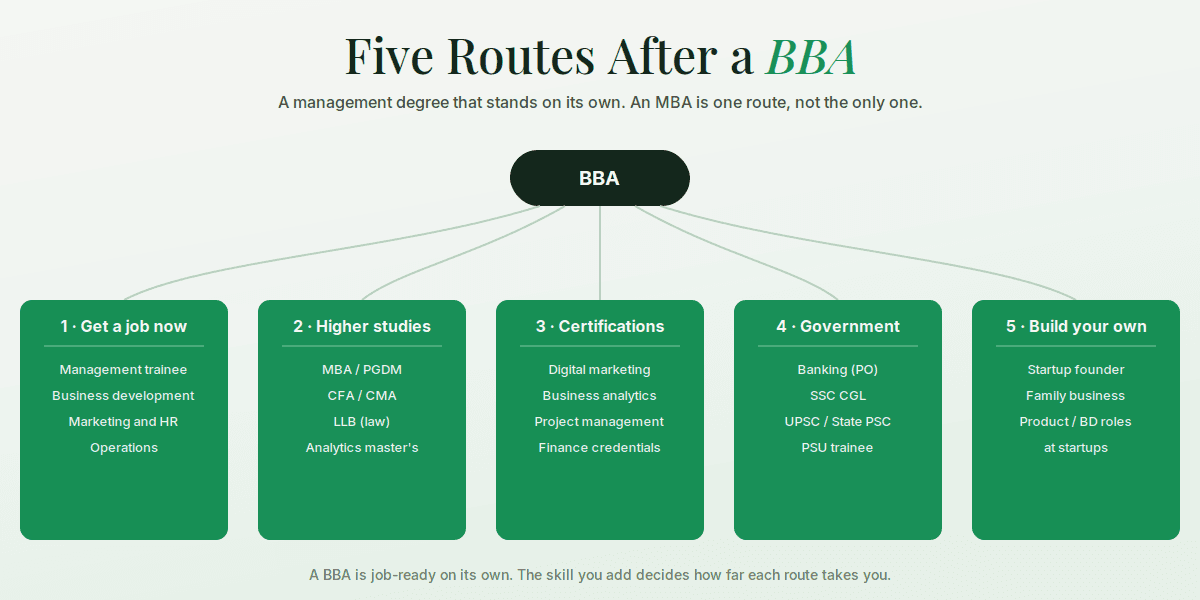
Those five directions are: starting a job now, going on to higher study, adding a professional certification, sitting for government and competitive exams, or building something of your own. Note where the MBA actually sits, tucked inside higher study as one choice among several, not the destination the whole degree is supposedly pointing at.
Route by Route, What Each Looks Like After BBA
Route 1: Get a job now
This is where a BBA quietly outperforms most other undergraduate degrees: it is built to be job-ready. The curriculum, marketing, finance, HR, operations, business administration, maps directly onto entry-level corporate roles, so a BBA graduate can step into real work without any further qualification.
Management trainee. A structured rotation through sales, marketing, HR and operations at a company, designed to build a broad understanding of the business and lead toward a management track. It is the classic BBA first job for a reason.
Business development. Sourcing leads, building client relationships and driving revenue, one of the most accessible and merit-rewarding starts, where results matter more than pedigree. Strong performers move quickly toward consulting-style roles, and our guide to becoming a management consultant traces one such path.
Marketing and HR. Marketing executive, digital marketing and HR executive roles suit the communication and people strengths a BBA builds, with clear ladders toward brand, growth and HR-business-partner roles.
Operations and banking. Operations executive roles keep a business running efficiently, and banking associate and relationship-manager roles offer a steady, well-structured start in the financial sector.
The honest note. Being job-ready is a real advantage, but it has a flip side: many BBA graduates start in similar entry-level roles, so what separates you is not the degree, which your peers also hold, but the specific skill or result you can show. |
Route 2: Higher studies (where the MBA is one option, not the only one)
If you want to accelerate past entry level or specialize, further study is a strong route, and here it is worth being clear that the MBA is one choice among several, answering the question so many BBA graduates actually ask: what can I do apart from an MBA?
MBA or PGDM. The most common choice, and a powerful one for reaching strategy, consulting and senior management faster. It is worth understanding how a PGDM compares with an MBA before choosing, and if the entrance exam is your concern, there are recognized routes to an MBA without CAT. But it is an accelerant, not a requirement.
CFA or CMA. For a BBA graduate drawn to finance specifically, the CFA (investment and portfolio work) or CMA (cost and management accounting) builds deep technical expertise that a general management degree does not, and can be a stronger fit than an MBA for a pure-finance career.
LLB (corporate law). A three-year law degree opens corporate law, compliance and business-litigation roles, a natural specialization for a management graduate interested in the legal side of business.
Specialized master's. Business analytics, digital marketing and international-business master's programs deepen one high-demand area without the breadth of a full MBA.

Route 3: Professional courses and certifications
Often the fastest way to sharpen a BBA into a specific, hireable skill, a focused certification takes months and targets exactly what employers want. The strongest options include digital marketing, business analytics (which pairs naturally with a management base and leads toward roles like business analyst), project management, and finance credentials for the numerically inclined. Each adds a demonstrable, job-ready layer on top of the degree.
Route 4: Government and competitive exams
A BBA graduate’s analytical and quantitative foundation is well suited to competitive exams, and several routes are open.
Banking. IBPS PO and SBI PO are a particularly natural fit for a management graduate, leading to probationary-officer roles with clear progression toward branch and senior management.
Staff selection. SSC CGL opens inspector, assistant and auditor roles across central ministries.
Civil services and state exams. UPSC Civil Services and state PSC exams are open to any graduate, and PSUs recruit management graduates into management-trainee and executive roles.
Route 5: Entrepreneurship and independent paths
This is arguably where a BBA has its most distinctive edge, because the degree literally teaches how to run a business: marketing, finance, operations and planning under one roof. Starting a venture, joining an early-stage startup in a business or product role, or professionalizing a family business are all natural next steps. For those who want to add network and structure to an idea, an MBA for entrepreneurs is one route, though many BBA graduates simply start, using what the degree already taught them.
Job Now, or Study More? Is an MBA Actually Necessary?
This is the question underneath the whole page, so here is the honest answer rather than the default “yes, do an MBA.”
You can build a strong career without an MBA. Because a BBA is job-ready, you can start now, prove yourself in a role, add a targeted skill or certification, and rise in performance. Plenty of successful managers and founders never did an MBA; they built a track record instead. Starting work also does not close the door, many people do an MBA later, with experience that makes it far more valuable.
An MBA helps most when it is an accelerant, not an escape. It genuinely speeds up the move into strategy, consulting and senior management, and widens the set of employers who will consider you. It is worth doing when you have a clear reason and, ideally, some experience behind you. It is a weaker choice when it is simply the expected next step, taken to postpone deciding what you actually want.
The honest bottom line: an MBA is a powerful option, not a mandatory gate. A BBA paired with real experience and a demonstrable skill competes well on its own, which is exactly why the “you must do an MBA” framing deserves to be questioned.
How to Choose Your Path: A Filter
Five routes is a lot to hold at once, so use a handful of honest questions to thin them out. Each answer pulls you toward some and rules others out.
Are you drawn to management breadth, finance depth, or building? Breadth points to management, consulting and the corporate track; finance depth points to CFA, CMA or a finance role; building points to startups and entrepreneurship.
Earn now, or invest in study first? If you want income and experience and can add a quick skill, a job now is defensible and often smart. If your target genuinely needs a further qualification, study first, ideally with a clear reason.
Stability, or growth and risk? Security favors the government and banking route; faster growth and higher variance favor private-sector roles and entrepreneurship.
Do you need an MBA, or just assume you do? Be honest about whether a specific goal requires one, or whether it is simply the expected move. The answer changes the whole plan.
Argue your value, or demonstrate it? If you would rather show real results, a project, a campaign, a venture, than rely on a credential, lean toward the skill-and-experience routes and roles that hire on demonstrated ability.
Work through those and the five usually collapse to one or two real contenders, which beats staring at the full menu of everything a management graduate could theoretically attempt.
Salaries at a Glance
BBA pay moves a lot with the role you pick, the skill you bring and the city you work in, so read the numbers below as rough opening marks, not guarantees, and put more weight on a role's typical middle than on its eye-catching ceiling.
Route / role | Indicative entry range (India) | Notes |
|---|---|---|
Management trainee | ~₹3.5–6 LPA | Leads toward a management track |
Business development / marketing | ~₹3–6 LPA | Rises fast on performance |
HR / operations | ~₹3–5.5 LPA | Steady, structured progression |
Banking and government | ~₹4–10 LPA | Plus security and allowances |
Post MBA / finance credential | ~₹6 LPA and up | Wide range; tier-dependent |
One thing stays true down every route: the graduates who brought a skill they could show, or an early record of results, pull ahead of those leaning on the degree by itself.
The Skills That Actually Get You Hired
Here is the idea that matters most, and it is also why the “a BBA is just a pre-MBA degree” worry misses the point. India's graduate-employability studies keep landing on the same uncomfortable number: only about half of graduates come out rated job-ready, and what the other half are missing is almost never the degree, it is a concrete skill they can put on the table. A BBA gives you a strong, job-ready base; what turns that base into a rising career is the skill and the results you add on top.
In practice that means concrete, showable things: a business-analytics or digital-marketing certification and a live project; financial-modeling skill for the finance track; a real internship or venture you can point to; a cleared exam for the government route. A focused certification plus a body of real work moves a BBA graduate past most of the field faster than another degree taken on autopilot. If corporate advancement is your specific aim, our guide to using an MBA for career growth shows how the management route compounds those skills, when you choose it deliberately.
There is also a route worth flagging for the BBA graduates who want to push deeper into management but is not sold on a conventional, lecture-driven MBA, which is a fair position to hold given everything above. A newer kind of program leads with practice over theory: admission turns on your profile rather than an entrance exam, and instead of working through cases, you build and run actual ventures. Scaler School of Business is one of these, an 18-month, build-first program in Management and Technology in Bengaluru, where students run live businesses on real capital rather than studying them from the outside.
The credential is a PGP certificate, not a UGC degree, which makes it a fit for people who would rather be measured by what they can do than by a formal qualification, and it belongs beside the routes above as one option, not a substitute for all of them. For a management graduate who wants the substance of a business education without automatically defaulting to an MBA, a build-first model is a genuinely relevant thing to weigh.

Frequently Asked Questions
Q1. Is a BBA useful without an MBA?
A: Yes. A BBA is a job-ready management degree that opens real entry-level corporate roles in marketing, HR, operations, business development and banking without any further study. An MBA can accelerate your career, but it is an option, not a requirement, and many successful managers and founders built strong careers on a BBA plus experience and skills.
Q2. What can I do after a BBA apart from an MBA?
A: Plenty. You can take a corporate job straight away, pursue a finance credential like the CFA or CMA, study law through an LLB, take business-analytics or digital-marketing certifications, prepare for banking and government exams, or start your own venture. The MBA is one route among many, not the only one worth considering.
Q3. Can I get a good job right after a BBA?
A: Yes, more easily than after many other undergraduate degrees, because a BBA is designed to be job-ready. Management trainee, business development, marketing, HR and operations roles are all open to fresh graduates. Adding a demonstrable skill, such as analytics or digital marketing, makes you noticeably more competitive.
Q4. What government jobs can I get after a BBA?
A: A BBA makes you eligible for banking exams like IBPS and SBI PO, SSC CGL, UPSC Civil Services and state PSC exams, and PSUs recruit management graduates into trainee and executive roles. The banking route in particular suits a management graduate's analytical and quantitative base.
Q5. Which is better after a BBA, an MBA or a CFA/CMA?
A: It depends on the career you want. An MBA suits general management, strategy and leadership across industries; a CFA or CMA suits a focused finance career, investment work for the CFA, cost and management accounting for the CMA. Choose the MBA for breadth and the finance credential for depth.
Q6. Can I become a CEO after a BBA?
A: Yes, in principle, though not immediately. A BBA is a strong starting point for a management career, and leadership roles come from a track record of results over years, often supplemented by an MBA or specialized experience along the way. The degree opens the path; performance walks it.
Q7. What is the highest-paying job after a BBA?
A: Early on, finance roles, investment and analyst positions, and consulting-track roles tend to pay most, with entrepreneurship offering the highest ceiling and the highest risk. Over time, pay tracks the specialization you build and the results you deliver more than the entry role itself.
Q8. Can I do an MBA after a BBA without CAT?
A: Yes. Many schools accept XAT, NMAT, SNAP or CMAT instead of CAT, and some newer, profile-based programs admit without any national entrance exam at all. A weak or missing CAT score does not close off the management route.
The Bottom Line
A BBA is not a placeholder for an MBA. It is a job-ready management degree that opens genuine paths across the corporate world, government, finance and entrepreneurship, all on its own. An MBA is one strong route among five, worth taking deliberately and for a clear reason, not because the degree supposedly demands it. Let your strengths and your timeline point you toward one or two of the routes, decide honestly whether you actually need further study, and then commit to building the skill and the track record that carry your chosen path forward. What you build on a BBA matters more than the letters that might come after it.

Non-IIM MBA
Top Non-IIM MBA Colleges in Bangalore (2026): Fees, Placements & How to Choose
5 min. read
MBA for Professionals
Is an MBA Worth It for Working Professionals? An Honest 2026 Guide
5 min. read

MBA for Engineers
MBA After B.Tech (2026): Eligibility, Specializations, Salary & Is It Worth It?
5 min. read
MBA for Engineers
MBA After Engineering (2026): Eligibility, Specializations, Salary & Is It Worth It?
5 min. read