MBA for Engineers
MBA After B.Tech (2026): Eligibility, Specializations, Salary & Is It Worth It?
Considering an MBA after B.Tech? This guide covers eligibility, entrance exams, specialization options for different engineering branches, career opportunities, expected salary ranges, and the differences between an MBA and an M.Tech. It also explores full-time, one-year, executive, online, and no-CAT routes to help B.Tech graduates choose a program based on their career goals, experience, learning preferences, and expected return on investment.
Team SSB
5 min. read
If you are an engineer thinking about an MBA, you are in a large company. Every year a big share of B.Tech graduates reach a point where the purely technical track starts to feel narrow, and the roles they want next, in product, strategy, consulting or leadership, call for a different set of skills. An MBA is one of the most established ways to make that move.
The honest answer to whether you should do one is that it depends on why. This guide covers an MBA after B.Tech for 2026 in full: whether you are eligible, which specialization suits your branch, the salary and roles it opens up, the routes that do not need a CAT score, and a clear framework for deciding. It also says plainly when an MBA is the wrong move, because that matters as much as when it is the right one.
It is also worth knowing that the choice is no longer only between traditional MBA colleges. A newer alternative has emerged for engineers who would rather learn by building than sit through theory - one that admits on the strength of your profile rather than a single entrance exam. Scaler School of Business is one of these, and it has its own section further down.
Can You Do an MBA After B.Tech?
Yes, and your branch does not limit you. MBA programs are built to take graduates from any discipline and add business and management skills on top, so a B.Tech in computer science, mechanical, civil, electrical or chemical engineering all qualify. The common bar is straightforward: a recognised bachelor’s degree, usually with about 50 per cent or more, and either a valid entrance score or, at some programs, a profile-based evaluation. Final-year students can normally apply too, subject to completing their degree. Eligibility is rarely the obstacle. The real questions are why you want the degree and which route fits you, which the rest of this guide works through.
Why Do an MBA After B.Tech?
An engineering degree gives you depth in how things work. An MBA adds the part that decides what gets built, funded and sold. For engineers, the combination is valuable for a few specific reasons.
Move from doing to deciding. An MBA helps you step out of execution and into the roles that set direction: product, strategy, operations and general management.
A sought-after combination. Employers value people who understand the technology and can run the business around it, which is exactly the profile a B.Tech plus an MBA creates.
Higher earning potential. Management and leadership roles generally pay more than entry-level technical ones, and the gap tends to widen over a career: in GMAC’s 2025 Corporate Recruiters Survey, the MBA was the highest-paid graduate credential.
A network you keep. The peers, faculty and alumni you meet open doors through referrals and mentorship long after you graduate.
A credible pivot. If you want to change industry or function entirely, the degree is a recognised reset of how recruiters see you.
Is an MBA After B.Tech Worth It?
For the right engineer, yes. If you have a clear goal, want to move into management or a business-facing role, and choose a program whose outcomes justify its cost, an MBA is one of the more reliable accelerators available. The value lies in the combination: deep technical understanding paired with the language and tools of business is hard to find and well paid.
It is a weaker bet when the reasons are vague. An MBA will not, on its own, fix job dissatisfaction or supply a direction you have not chosen. Judge it the way you would any investment: by the median salary its graduates actually earn, the share of the cohort that gets placed, and how quickly a realistic package pays back the fees and the time away.
Who Should Think Twice About an MBA After B.Tech
An MBA is not the right next step for everyone with a B.Tech. Pause if any of these sound like you.
You want to go deeper, not broader. If your goal is to become a stronger engineer in machine learning, data or systems, a master’s such as an M.Tech or M.S., or a focused certification, will usually serve you better than a general management degree.
You cannot yet name the role you want. Doing an MBA to escape a job you dislike, with no clear destination, rarely pays off.
The numbers do not work yet. If the best program open to you now carries fees a realistic package would struggle to justify, it can be worth waiting and applying from a stronger position.
You would gain more from experience first. Two or three years of real responsibility often compound faster than a degree taken too early, and they make you a stronger applicant later.
None of this rules an MBA out. It simply means the timing or the path may be different for you.
Which MBA Specialization Suits Your B.Tech Background?
There is no single best specialization. The right one depends on your branch, your strengths and where you want to work. Use this mapping as a starting point rather than a rule.
B.Tech Branch | Specializations That Fit Well | Why |
|---|---|---|
Computer Science / IT | Product Management, Business Analytics, Technology & IT Management | Builds on your software fluency for product and tech-driven roles |
Mechanical | Operations, Supply Chain, Industrial Management | Extends your grasp of processes into operations and logistics leadership |
Electrical / Electronics | Energy Management, Technology Management, Operations | Fits leadership roles in energy, utilities and hardware-tech firms |
Civil | Project Management, Infrastructure & Real Estate Management | Moves you into strategic oversight of large projects and developments |
Chemical | Operations, Supply Chain, Environmental & Sustainability Management | Aligns with process industries, manufacturing and the sustainability shift |
Any branch | Finance, Marketing, Consulting, General Management | Open routes if you want a clean pivot away from your technical base |
The point is to choose for where you are going, not only for where you have been. If you want a complete change of direction, the broad functions like finance, marketing and consulting are open to you regardless of branch.
Career Paths & Roles After an MBA
A B.Tech and an MBA together open roles that neither degree reaches alone.
Product management: owning a product from strategy to launch, where your technical fluency is a real edge.
Management consulting: solving business problems for clients, where the structured thinking engineers bring is prized.
Operations and supply chain: running the systems that make a business work, a natural fit for many branches.
Business and data analytics: turning data into decisions, where a quantitative background helps.
Finance and marketing: open routes for those who want a fuller pivot away from engineering.
Entrepreneurship: the technical-plus-business combination is a strong foundation for building your own company.
Recruiters across consulting, technology, finance and manufacturing actively seek this dual profile, from the major consultancies to large technology and FMCG companies.
Salary After an MBA for B.Tech Graduates
Salaries vary widely by institute, role and city, so treat any figure as a guide rather than a promise. As a broad picture, a pre-MBA engineer in India often earns somewhere around ₹3.5 to 7 lakh a year (AmbitionBox, 2026), while graduates of strong MBA programs commonly move into roles paying ₹15 to 30 lakh or more (institute placement reports, 2025–26; IIM Bangalore’s 2026 cohort averaged ~₹32.6 lakh and ISB’s ~₹37.3 lakh), with top institutes and roles going higher.
Role | Indicative Range |
|---|---|
Product Manager | ~₹18–30 LPA |
Strategy / Management Consultant | ~₹18–30 LPA |
Finance Manager | ~₹10–22 LPA |
Business Analyst | ~₹10–18 LPA |
Marketing Manager | ~₹8–20 LPA |
Operations Manager | ~₹8–18 LPA |
Indicative 2026 ranges, compiled from AmbitionBox and institute placement reports; top IIM, ISB and global-school outcomes can exceed these.
Two honest adjustments before you trust any average. Look at the median rather than the mean, since a few large offers can lift the headline well above what a typical graduate earns, and ask for the placement rate, because a high average means little if only part of the cohort was placed. A reasonable target is to recover the total program cost within three to five years through the post-MBA salary uplift.
Choosing the Right Program: Full-Time, 1-Year, Executive or Online
There are four broad formats, and the right one depends mostly on your stage.
Format | Best suited to | Note |
|---|---|---|
Full-time, 2-year | Freshers and early-career (0–3 yrs) | Full internship-to-placement cycle |
Full-time, 1-year | Experienced professionals (4–8 yrs) | Accelerated, lower opportunity cost |
Executive | Working professionals (5+ yrs) | Keep your job, weekend classes |
Online | Upskillers staying in role | Maximum flexibility |
Build-first (e.g. SSB) | B.Tech graduates and career switchers who want to build and learn side by side | Profile-based, no CAT; live D2C business, three AI products, six-month venture program |
If you are a fresher or early in your career, a full-time two-year program or a build-first program usually fits best. If you already have several years behind you, a one-year or executive format is more efficient. For a deeper look at the accelerated route, see our guide to the best one-year MBA programs in India. Be honest about your stage rather than choosing on brand alone.
Eligibility & Entrance Exams, Including the No-CAT Routes
The common eligibility bar is a recognised bachelor’s degree, typically with around 50 per cent or more, with relaxations for reserved categories at many colleges. Final-year students can usually apply. On exams, you have more options than CAT alone.
CAT is the most widely accepted, and the route for the IIMs and many top schools.
XAT, NMAT, SNAP, CMAT, MAT and ATMA are accepted across a wide range of private and state institutes.
The GMAT is useful for one-year, executive and globally oriented programs.
Skipping CAT entirely? You still have real options. Many colleges admit through XAT, NMAT, SNAP or CMAT, and some newer programs admit entirely on profile. Scaler School of Business, covered in the next section, weighs your academics, projects, initiative and potential rather than a single exam. If you have deliberately stepped off the CAT and IIM track, this is a credible and considered path, not a fallback. |
A Future-Ready MBA Alternative: Scaler School of Business
If part of why you are reading this is that you want something more hands-on than a traditional classroom, there is a different option worth knowing. Scaler School of Business runs a full-time, 18-month program in Management and Technology in Bengaluru, and it admits students on the strength of their profile and personal interview rounds. Where a conventional MBA teaches business largely through theory and cases, SSB is built around actually building things, which tends to suit engineers.
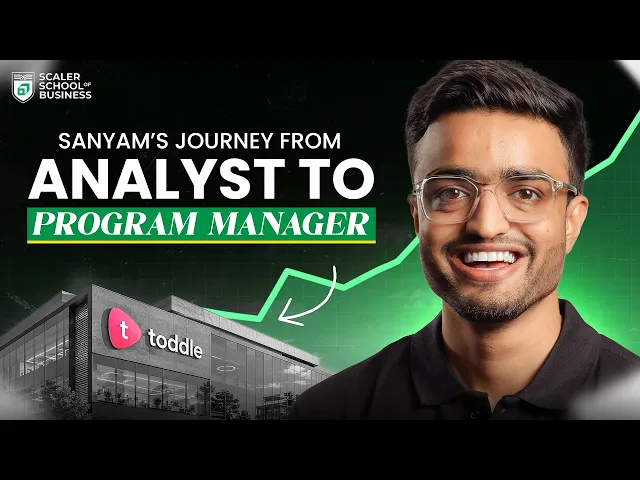
Sanyam’s Journey | B.Tech → Deloitte → SSB → Product Manager at Toddle
A few of the things that set it apart:
You build and ship, not just study. Students launch three real AI products and spend more than 150 hours working hands-on with over 25 tools across more than ten workshops.
You run two live businesses. A Direct-to-Consumer challenge, where teams build a real brand and chase revenue within a few weeks on real startup capital, and a six-month venture program that takes an idea from prototype to revenue, and in some cases to raising money from investors.
You work on real company problems. More than ten company-sourced projects guided by over a hundred industry leaders, alongside a full internship.
You learn from operators. Much of the faculty are working leaders rather than career academics, including names such as Dr. Narahari Hansoge(IIM Bangalore), Vidit Jain (Ex-McKinsey), Dr, Akash Krishnan (Gartner), Sucheta Mahapatra (Airtel), Manish Pansari (Myntra).
You build inside a startup ecosystem. The Scaler Innovation Lab sits steps from class, so you prototype and ship alongside real founders.
It tends to suit exactly the engineers a traditional route can overlook. The B.Tech graduate who wants to move beyond a purely technical role into product, strategy or management. The fresh graduate or early-career professional who wants a fast, practical start. The career switcher changing function or industry. And the aspiring founder who wants the frameworks, the network and the practice before building a company of their own.
How to Get In: Application, Profile & Prep
Whichever route you choose, the application tends to ask for similar things. Plan for a strong statement of purpose that connects your engineering background to where you want to go, two recommendation letters from managers or professors, and a resume that highlights impact rather than duties. Many programs add a group discussion, a written ability test and a personal interview, so practise articulating your goals clearly.
On timing, most programs admit in rounds, and applying in the first round usually improves both your chances and your scholarship odds. If a test is involved, give yourself three to six months to prepare, and start your essays early rather than in the final week. As a rule, begin a full cycle ahead of the intake you want.
How to Decide: A B.Tech Graduate’s Framework
Before you commit, run your situation through a few questions.
Goal clarity. Can you name the role you want to be in afterwards? If not, it is usually better to wait.
Format fit. Does your stage suit a two-year, one-year, executive or build-first program?
Specialization fit. Does the program go deep where you want to work?
Return. Set the fees against a median package and your current salary.
Learning model. Do you learn best through lectures and cases, or by building and shipping? This single question separates a traditional MBA from a build-first program.
Common Mistakes B.Tech Graduates Make When Choosing an MBA
Even engineers who decide an MBA is right often stumble on the same execution errors. Watch for these.
Applying with no clear goal, and hoping the degree will supply one. A CS graduate applies the year they finish because their batchmates are, picks marketing off the brochure, and a year in realises they wanted product management all along ,a pivot they could have planned from the start.
Choosing on brand alone, without checking whether the program fits how you want to work. An engineer turns down a school strong in product and analytics for a higher-ranked general one, then spends placements chasing finance roles they never wanted, against candidates who actually came from finance.
Ignoring the learning model, and ending up in a theory-heavy classroom when what you wanted was to build. Someone who learns by doing enrols in a lecture-and-case program, sits through two years of frameworks, and graduates having never shipped a thing, the exact gap they hoped the MBA would close.
Underestimating the true cost, which includes the income you give up, not only the fees. A candidate weighs a ₹12 lakh program against a ₹20 lakh one on fees alone, forgetting that two years out of a ₹7–8 lakh job adds roughly ₹15 lakh of foregone earnings to either - which shrinks the real gap between them to far less than the sticker prices suggest.
Treating the entrance exam as the only door, and missing the profile-based and alternative-exam routes entirely. A mechanical engineer with strong internships and a robotics side project gives up after one middling CAT attempt, never applying to the profile-based programs that would have valued exactly that record.
Frequently Asked Questions
Q1. Can I do an MBA after B.Tech?
A: Yes. An MBA is open to graduates of every engineering branch. You will usually need a recognised degree with around 50 per cent and either an entrance score such as CAT, XAT or GMAT, or a profile-based evaluation at programs that do not require an exam. Final-year students can normally apply too.
Q2. Is an MBA after B.Tech worth it?
A: For an engineer with a clear goal who wants to move into management, product or consulting, yes. Judge it by the median package, the placement rate and the payback rather than brand alone. It is a weaker choice if your goals are unclear.
Q3. Which MBA specialization is best after B.Tech?
A: It depends on your branch and goal. Computer science fits product and analytics, mechanical fits operations and supply chain, civil fits project and infrastructure management, and any branch can move into finance, marketing or consulting. See the specialization table above.
Q4. What salary can I expect after an MBA following B.Tech?
A: Broadly ₹8 to 30 lakh a year from strong programs, depending on role - marketing and operations roles toward the lower end, and product, consulting and analytics roles at roughly ₹18 to 30 lakh (see the salary table above). Top IIM, ISB and global-school graduates go beyond ₹35 to 40 lakh. Figures vary widely, so check current placement reports.
Q5. Should I do an MBA or an M.Tech after B.Tech?
A: Choose an M.Tech or M.S. if you want to go deeper technically, into research or specialist engineering roles. Choose an MBA if you want to move into management, product, consulting or business roles.
Q6. Can a fresher do an MBA right after B.Tech?
A: Yes. Two-year full-time programs and build-first programs such as Scaler School of Business are open to freshers, while one-year and executive programs usually expect a few years of work experience.
Q7. Can I do an MBA after B.Tech without CAT?
A: Yes. Many colleges accept XAT, NMAT, SNAP, CMAT or MAT instead of CAT, and some programs, including Scaler School of Business, admit entirely on a profile-based evaluation with no entrance exam.
Q8. Do I need work experience for an MBA after B.Tech?
A: Not for most two-year and build-first programs, which accept freshers. Executive and one-year programs generally prefer or require a few years of experience.
Q9. Is an MBA after B.Tech good for IT and software engineers?
A: Often, yes, especially for a move into product management, strategy or general management. An engineer who wants to stay deep in software may gain more from focused certifications or an M.Tech.
Your Next Steps
If you have decided to take this seriously, here is a simple order to work in.
Write down the role you want to be in three to five years from now.
Map your branch and strengths to a specialization using the table above.
Shortlist programs by format and realistic return, not by brand alone.
Decide your admission route: an entrance exam, or a profile-based program.
Prepare your profile, essays and timeline, and start a full cycle ahead of the intake.
If a build-first route appeals, book a session or take the Good Fit check to see where you land.
The Bottom Line
An MBA after B.Tech is a powerful move for the engineer with a clear goal and the numbers to back it. It turns deep technical knowledge into the broader business judgement that leadership, product and consulting roles reward. It is the wrong move if you choose on brand alone, stretch the finances, or expect it to supply a direction you have not chosen.
If what drew you here was the wish for something more practical than a traditional classroom, a build-first option such as Scaler School of Business, with its focus on real products, live businesses and learning by doing, is designed for engineers, switchers and aspiring founders who want to graduate to be able to build, not only to describe. Whichever route you choose, let the decision rest on your goals and the stage of your career.
Non-IIM MBA
Top Non-IIM MBA Colleges in Bangalore (2026): Fees, Placements & How to Choose
5 min. read
MBA for Professionals
Is an MBA Worth It for Working Professionals? An Honest 2026 Guide
5 min. read

MBA for Engineers
MBA After B.Tech (2026): Eligibility, Specializations, Salary & Is It Worth It?
5 min. read
MBA for Engineers
MBA After Engineering (2026): Eligibility, Specializations, Salary & Is It Worth It?
5 min. read