MBA for Non-Tech
Career Options After BCom: Jobs, Higher Study, Salaries and How to Choose
Explore the best career options after BCom, including finance jobs, higher studies, CA, CFA, government exams, entrepreneurship and how to choose the right path based on your goals, timeline and the skills you want to build.
Team SSB
5 min. read

A lot of BCom graduates carry the same quiet worry: that a plain BCom is somehow low-value, and that you are expected to stack a CA or some other credential on top before the degree counts for anything. It is worth settling that at the start. A BCom is a genuine foundation in finance, accounting and taxation, and it opens real, paid jobs on its own. The professional courses that sit above it, CA, CFA and the rest, are powerful accelerants, not a compulsory tax you must pay to have a career.
That said, this is a degree that rewards adding a credential or a skill more than most, which is exactly why the career options after BCom span such a wide range: direct finance jobs you can take now, some of the highest-ceiling professional qualifications in the country, government exams where your commerce knowledge is a real edge, and more. The difficulty is choosing among them. This guide maps the five routes, shows what each looks like for a commerce graduate, answers the “do I actually need CA” question honestly, and then helps you narrow the field to fit you.
At a glance. A BCom opens five routes: a job now, higher studies, professional courses, government and competitive exams, and entrepreneurship. Two honest points run through them: a BCom is directly employable in finance and accounting on its own, and a professional course such as CA or CFA is a powerful accelerant rather than a mandatory gate. Across every route, the credential or skill you add is the multiplier. |
The Five Routes After BCom
A commerce graduate's options land more clearly as five directions than as a long roster of jobs and courses. Nearly everything worth considering fits into one of them, and for a BCom, one of the five, professional courses, pulls more weight than it does for almost any other degree.
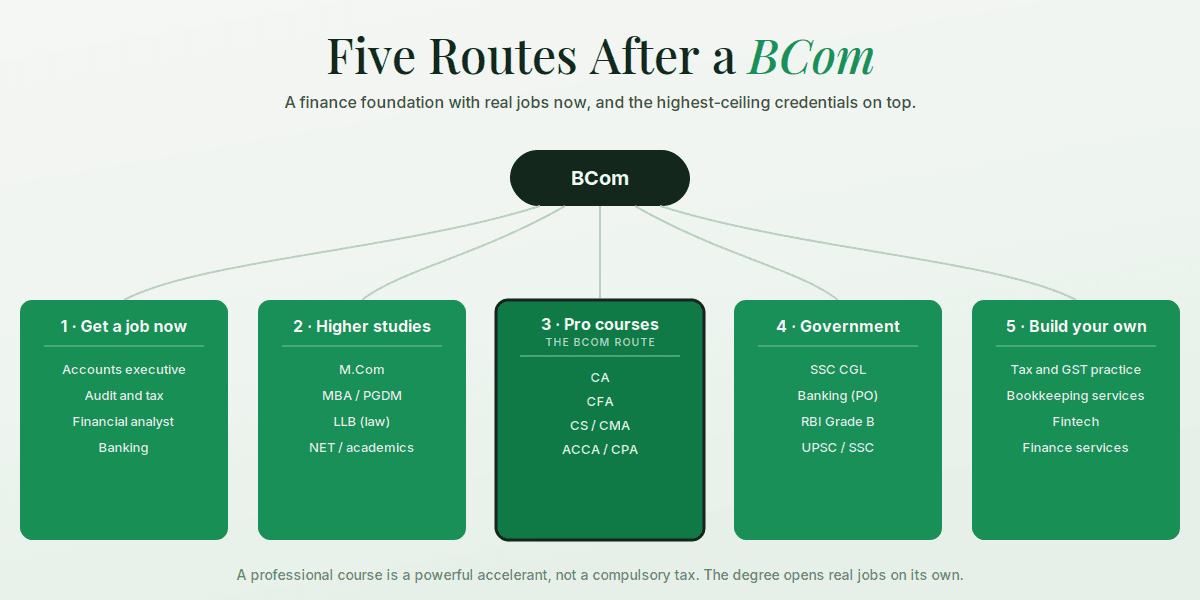
Those five directions are: taking a finance job now, going on to higher study, committing to a professional course, sitting for government and competitive exams, or building something of your own. Notice that professional courses are highlighted here, because for a commerce graduate that route is where the highest ceilings, and the degree's most distinctive edge, tend to sit.
Route by Route, What Each Looks Like After BCom
Route 1: Get a job now
A BCom is directly employable, more so than the “low-value” reputation suggests, because it maps onto the finance and accounting functions every business needs. The core roles open to a fresh commerce graduate are concrete.
Accounts and audit roles. Accounts executive, audit associate and tax associate roles, including at the Big 4 firms (Deloitte, EY, KPMG, PwC), handling ledgers, financial statements, compliance and GST. These are the roles a BCom was built for.
Financial analyst. Evaluating financial data, budgeting and building simple models at banks, corporates and analytics firms, one of the higher-paying direct entry points for the numerically strong.
Banking and relationship roles. Relationship manager and retail-banking roles at private banks offer a structured, well-defined start in the financial sector.
Tax and accounts support. Tax consulting support, accounts payable and receivable, and finance operations roles across MNCs and fintech firms, steady entry points that value commerce fundamentals.
The honest note. A BCom gets you in the door, but the better direct roles increasingly expect a practical skill on top, Excel and financial modeling, Tally, GST filing, or basic analytics. The degree plus one of these is far more employable than the degree alone, which is the theme this guide keeps returning to. |
Route 2: Higher studies
If you want to deepen your subject or pivot, further study is a route, though for a BCom it often sits alongside, rather than above, the professional-courses route that follows.
M.Com. A two-year deepening of commerce and accounting, and the standard step toward academics, a PhD or the UGC-NET for college teaching.
MBA or PGDM. The management pivot, opening strategy, consulting and leadership roles beyond pure finance. It is worth understanding how a PGDM compares with an MBA, and if the entrance exam concerns you, there are recognized routes to an MBA without CAT.
LLB (corporate law). A three-year law degree pairs unusually well with a commerce background, opening corporate law, compliance and business-litigation roles.

Route 3: Professional courses, the defining BCom route
This is where a BCom graduate has options few other degrees offer, and where the highest ceilings sit. These are demanding, multi-year qualifications, but they transform earning potential and are the reason commerce is such a strong undergraduate choice.
CA (Chartered Accountancy). The gold standard, and the highest-return course for a commerce graduate targeting audit, taxation and corporate finance. A BCom allows direct entry to the Intermediate level. Qualified CAs at top firms start strongly and see earnings rise substantially with experience. It is demanding and has real failure rates, but the ceiling is among the highest available.
CFA (Chartered Financial Analyst). The global standard for investment management, equity research and portfolio work, ideal for a commerce graduate aiming at investment banking or global finance.
CS and CMA. The Company Secretary qualification centers on corporate governance and compliance; the Cost and Management Accountant qualification centers on costing and financial control, each a respected, specialized path.
Global credentials (ACCA, CPA). ACCA and the US CPA suit those aiming to work with multinationals or abroad, built around international financial-reporting standards.
Fast short courses. For quicker employability, financial modeling, GST practitioner certification, Tally and data analytics take months rather than years and directly raise your starting prospects.
Route 4: Government and competitive exams
A commerce background is a genuine advantage in several government exams, because the syllabi lean on accounting, finance and economics you already know.
SSC CGL. Recruits for tax assistant, auditor, accountant and junior statistical officer roles across central ministries, positions a commerce graduate is directly suited to.
Banking. IBPS PO and SBI PO for public-sector banks, and RBI Grade B, the most prestigious banking exam open to graduates, working in monetary policy and banking supervision.
UPSC and direct-hire bodies. UPSC Civil Services allows Commerce and Accountancy as a scoring optional subject, and bodies like the CAG and SEBI recruit commerce graduates directly for audit, accounts and finance roles.
Route 5: Entrepreneurship and independent paths
A commerce foundation supports several independent paths directly. A tax, GST and bookkeeping practice can be built on BCom knowledge plus a short certification; fintech and finance-services ventures draw on the same base; and freelance finance and accounting work is in steady demand from small businesses. For those who want to add business breadth and a network to a venture, an MBA for entrepreneurs is one route, though many start with the practical finance skills the degree already provides.
Job Now, or Study More? Do You Actually Need CA?
Everything above circles back to this one question, so it deserves a straight answer instead of the reflexive "obviously, do CA."
You can build a solid finance career without CA. A BCom plus a practical skill, financial modeling, analytics, GST and Tally, gets you into accounts, analyst and finance-operations roles now, and you can rise through experience and further certifications later. Many capable commerce graduates never do CA and build strong careers in analysis, banking, fintech and operations.
A professional course transforms the ceiling, at a real cost. CA and CFA genuinely lift earning potential into a different bracket over time, but they take years, demand sustained effort, and have real failure and dropout rates. They are worth it when deep technical finance is genuinely where you want to be, and an expensive detour when taken only because everyone says you should.
Put plainly: a professional course lifts your ceiling, but it is not the turnstile you have to pass through to have a career. A BCom with a demonstrable skill attached is a quicker, lower-risk way in that serves plenty of graduates well, and the credential is always available later, once you actually know you want it.
How to Choose Your Path: A Filter
Five routes is more than anyone can weigh at once, so a few blunt questions do the narrowing for you.
Deep finance specialist, or a broader path? If you want to be the technical expert, a professional course like CA or CFA is built for that. If you want breadth or a pivot, a job plus skills, or an MBA, may fit better.
Earn now, or commit to a multi-year credential? If you want income and experience soon, start with a job and a short skill. If you are certain about deep finance and can commit the years, a professional course pays off.
Stability, or growth and risk? Security favors the government and banking route; higher growth and variance favor private finance, fintech and entrepreneurship.
Stay in finance, or pivot toward analytics and business? Staying favors CA, CFA and finance roles; pivoting favors data analytics, business analysis or a management route, all reachable from a commerce base.
Credential, or demonstrable skill? Some ceilings need a formal qualification; many roles now hire on a demonstrable skill and a track record. Be honest about which your target actually requires.
Work through them and the five usually shrink to one or two that actually fit, which is a far better place to begin than the full spread of everything a commerce graduate might do.
Salaries at a Glance
Pay after a BCom varies widely by route, credential and city, so treat these as indicative starting points, and read the professional-course figures as post-qualification and post-experience, not day-one.
Route / role | Indicative range (India) | Notes |
|---|---|---|
Accounts / audit / tax (entry) | ~₹3–7 LPA | Higher at Big 4 with skills |
Financial / business analyst | ~₹4–8 LPA | Rises with modeling and analytics |
Banking and government | ~₹4–13 LPA | RBI Grade B at the top end |
CA / CFA (qualified) | ~₹7 LPA and up | Reaches ₹15–25 LPA with experience |
Post MBA / management pivot | ~₹6 LPA and up | Wide range; tier-dependent |
The shape of it is clear: professional-course routes reach the highest ceilings, but only after years of study and experience, while job-plus-skill routes start sooner and lower. And on every one of them, the same thing holds, the graduate carrying a skill they can show ends up ahead of the one leaning on the degree by itself.
The Skills That Actually Get You Hired
Here is the idea that matters most, and it is the honest answer to the “is a plain BCom low-value” worry. The employability surveys out of India keep returning the same blunt figure: roughly half of graduates are rated job-ready, and for the rest the missing piece is almost never the degree, it is a specific skill they can actually demonstrate. A BCom gives you a strong finance foundation; what turns it into a rising career is the credential or skill you stack on top.
For a commerce graduate that means concrete things: financial modeling and advanced Excel; GST and Tally for accounts and tax roles; and increasingly, data and analytics skills, which open the fast-growing pivot from commerce into business analysis and data-analyst roles that pay well and are hungry for people who understand both numbers and business. A focused three-to-nine-month course plus real practice moves you past most of the field. If corporate advancement is your specific aim, our guide to using an MBA for career growth covers how the management route compounds those skills.
One route is worth naming for a particular commerce graduate: the one who works out, partway through, that what pulls them is business, product and building rather than deep technical finance. If your aim is CA or CFA and mastery of audit, tax or investment analysis, a professional course is the right tool and a build-first program is not what you are after, plainly. But if you are leaning toward management, product or running a venture, there is a newer kind of program that puts practice ahead of theory: admission rests on your profile rather than an entrance exam, and students build and run real businesses rather than read about them.
Scaler School of Business is one of these, an 18-month, build-first program in Management and Technology in Bengaluru. To be candid about what it is, the credential is a PGP certificate, not a UGC degree, so it fits people who would rather be judged on what they can do than on a formal qualification, and it stands as just one of the routes above, most relevant to the commerce graduate pivoting toward business rather than deep finance.

Frequently Asked Questions
Q1. Is a BCom enough to get a job?
A: Yes. A BCom qualifies you directly for accounts, audit, tax, financial-analyst and banking roles, including at the Big 4 and private banks. The honest caveat is that the better roles increasingly expect a practical skill on top, such as financial modeling, Tally, GST or analytics, so a BCom plus one of these is far more employable than the degree alone.
Q2. Do I have to do CA after BCom?
A: No. CA is a powerful accelerant that raises your ceiling significantly, but it is not mandatory. Many commerce graduates build strong careers through a job plus practical skills, an MBA, banking exams or other professional courses. Do CA if deep technical finance is genuinely where you want to be, not because it is the expected default.
Q3. What can I do after BCom without CA?
A: A great deal: take a finance or accounting job now, pursue a CFA, CS, CMA or an MBA, prepare for banking and government exams, move into data analytics or business analysis, or start a finance or tax practice. CA is one high-ceiling option among several, not the only worthwhile path.
Q4. Which is best after BCom, CA, CFA or MBA?
A: They serve different goals. CA suits deep audit, tax and corporate finance; CFA suits investment management and equity research; an MBA suits broader management, strategy and leadership roles. Choose CA or CFA for finance depth and an MBA for management breadth, based on the career you actually want.
Q5. What government jobs can I get after BCom?
A: A BCom makes you eligible for SSC CGL (tax assistant, auditor, accountant), banking exams like IBPS and SBI PO, the prestigious RBI Grade B, and UPSC Civil Services, where Commerce and Accountancy is a scoring optional. Bodies like the CAG and SEBI also recruit commerce graduates directly.
Q6. Can a BCom graduate earn 1 lakh a month?
A: Yes, though usually not at entry level. Reaching that range typically means a professional qualification like CA or CFA with a few years of experience, a strong role at a top firm, or a specialized skill such as financial modeling or analytics that commands a premium. The degree opens the path; the credential or skill and experience get you there.
Q7. What is the best course after BCom for a high salary?
A: CA offers the highest long-term ceiling for finance and audit careers, CFA for investment roles, and an MBA in finance for the fastest route into senior management. For quicker returns, financial modeling and data-analytics certifications raise your starting prospects within months rather than years.
Q8. Can I move into tech or analytics after BCom?
A: Yes, and it is one of the strongest modern pivots. Data and business analytics build directly on the numerical comfort a commerce degree develops, and a focused analytics certification plus a portfolio can open analyst roles that pay well and value people who understand both data and business.
The Bottom Line
A BCom is not a low-value placeholder. It is a genuine finance-and-accounting foundation that opens real jobs on its own and sits beneath some of the highest-ceiling professional qualifications in the country. Those courses, CA, CFA and the rest, are powerful accelerants worth pursuing deliberately, not a compulsory tax you must pay to justify the degree. Let your goals and your timeline point you toward one or two of the five routes, decide honestly whether you need a multi-year credential or whether a job plus a skill starts you faster, and then commit to stacking the credential or skill that fits your ceiling. What you build on a BCom is what turns it into a career.

Non-IIM MBA
Top Non-IIM MBA Colleges in Bangalore (2026): Fees, Placements & How to Choose
5 min. read
MBA for Professionals
Is an MBA Worth It for Working Professionals? An Honest 2026 Guide
5 min. read

MBA for Engineers
MBA After B.Tech (2026): Eligibility, Specializations, Salary & Is It Worth It?
5 min. read
MBA for Engineers
MBA After Engineering (2026): Eligibility, Specializations, Salary & Is It Worth It?
5 min. read