Business Management Glossary
Levels of Management: The Three Tiers and What Each One Does
Understand the three levels of management — top, middle and lower — including what each level does, how authority and responsibility flow through an organization, and which skills matter most at each stage.
Team SSB
5 min. read
A company decides to open in a new city. One person approves the decision to expand at all. A different person plans how the launch actually happens. A third runs the store once it opens. Same decision, three completely different jobs. That gap is what the levels of management describe: how the authority to get things done is layered in an organization, who sets direction, who translates it into plans, and who oversees the work itself.
Most organizations settle into three tiers, usually drawn as a pyramid, with a few senior people at the top and progressively more managers toward the base. This entry covers what each tier does, the different skills each one depends on, why the layers exist at all, and how authority and responsibility travel between them.
Short answer. The three levels of management are top-level, which sets the organization’s direction and long-term strategy; middle-level, which turns that strategy into departmental plans and coordinates across units; and lower or supervisory level, which oversees the daily work of the non-managerial workforce. Authority is widest at the top and narrows toward the base, while the number of managers does the reverse. |
The Three Levels of Management
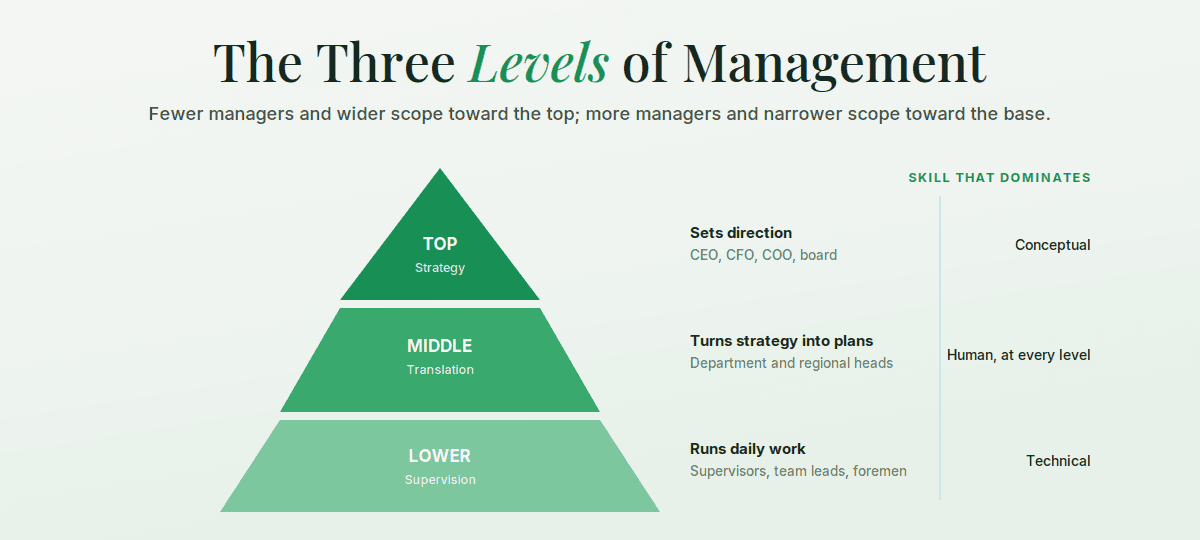
Each tier works on a different time horizon and answers to the one above it. Follow that same expansion decision down the pyramid and watch the objective change shape at every level.
Top-level management
The top level is the small group of senior executives responsible for the organization as a whole: the chief executive, the other C-suite officers such as the chief financial and chief operating officers, the managing director, and the board that oversees them. They hold the widest authority and answer directly to owners or shareholders rather than to another manager.
Their work is strategic and long-range. They set the organization’s objectives, decide which markets and products it will pursue, approve major investments and budgets, and appoint the executives who run the levels below. They also face outward, reading the economy, competition and regulation for threats and opportunities that will matter in years rather than weeks. In the move into a new city, the top level makes the decision itself: whether to expand at all, how much capital to commit, and what the expansion is meant to achieve.
Middle-level management
The middle level is the layer of departmental, divisional and regional heads who report to the top and have supervisory managers reporting to them. It is the largest managerial layer in most organizations of any size, and it exists to connect strategy to execution.
Middle managers take the broad objectives handed down and turn them into concrete plans for their own department or region: targets, timelines, budgets and staffing. They acquire and train the people their unit needs, coordinate horizontally with other departments so that the parts do not pull against each other, and report performance back upward. In the city expansion, the middle level decides how it actually happens: the regional head plans the launch for that market, hires the local team, and aligns marketing, supply and operations behind the opening.
Lower-level (supervisory) management
The lower level, also called supervisory or frontline management, is the tier in direct contact with the non-managerial workforce: supervisors, team leaders, shift managers and foremen. It is the most numerous managerial group and the one closest to the actual work.
Supervisors spend most of their time directing and supporting workers rather than planning. They assign daily tasks, oversee output against quality standards, handle immediate problems and grievances, enforce safety and discipline, and pass workforce feedback up to the middle level. Their horizon is short, often the current shift or day. In the new city, the lower level runs the store or site once it opens: allocating the day’s work, keeping service or output to standard, and reporting what is happening on the ground back up the line.
Level | Primary focus | Typical titles | Time horizon |
|---|---|---|---|
Top | Strategy and overall direction | CEO, CFO, COO, MD, board | Years |
Middle | Turning strategy into departmental plans | Department, division and regional heads | Months to a year |
Lower | Supervising daily work | Supervisors, team leaders, foremen | Days to weeks |
The Skills Each Level Needs, and How the Mix Changes
Every manager draws on the same three kinds of skill, identified by the social scientist Robert Katz: technical, human and conceptual (Harvard Business Review). What changes across the levels is not which skills are used but how much each one matters.
Technical skill is the ability to perform or understand the specific work, the tools, methods and processes of the job. It matters most at the supervisory level, where a manager has to understand the work well enough to direct it and judge its quality, and it becomes less central higher up.
Human skill is the ability to work with and through people: to communicate, motivate, resolve conflict and lead. It is the one skill that matters roughly equally at all three levels, because every manager, from the shift supervisor to the chief executive, gets results through other people.
Conceptual skill is the ability to see the organization as a whole, to understand how the parts affect each other and to reason about the business in the abstract. It matters most at the top, where decisions are broad and their consequences distant, and it is needed least by a frontline supervisor.
The practical consequence is that a promotion is rarely a matter of doing more of the same job. Moving from supervisor to department head, and again from department head to the executive suite, shifts the demand away from technical skill and toward conceptual skill, while human skill stays essential throughout. A person who reached the supervisory level on technical strength alone often finds the higher levels ask for something they have not yet built, which is why capable specialists do not automatically become capable executives.
Why Organizations Have Levels at All
The pyramid is a consequence of a simple limit: one manager can only directly supervise so many people before attention runs thin. That limit is called the span of control, and it is what forces an organization to add layers as it grows.
A founder with five people needs no levels; everyone reports to one person. Add enough people and no single manager can oversee them all, so some are made supervisors, and the founder now manages the supervisors rather than the workers. Grow again and a middle layer appears between the two. Each level exists because the one above it ran out of span, not because hierarchy is desirable in itself.
This also explains the difference between a tall organization and a flat one. A narrow span of control produces many levels and a tall pyramid, which gives tight supervision but slows decisions as they pass through more hands. A wide span produces few levels and a flat structure, which moves faster and costs less but stretches each manager thinner. Neither is correct in the abstract; the right shape depends on how complex and how standardized the work is.
How Authority and Responsibility Move Between Levels
The pyramid is held together by a few rules about how authority, responsibility and information travel through it.
Authority delegates downward. Each level passes some of its decision-making power to the level below so that work can happen without every choice climbing to the top. A supervisor can approve a shift change without asking the CEO because that authority has been delegated down the chain.
Responsibility flows upward, and cannot be given away. A manager who delegates a task remains answerable for its outcome. Authority can be handed down; the accountability for how it is used stays with the person who delegated it, which is why senior managers are held responsible for failures several levels beneath them.
Information travels both ways. Objectives, plans and instructions move down the levels; results, feedback and problems move up. A blockage in either direction is a common failure, since a top level that hears no bad news from the floor is managing on a picture that is out of date.
Two ideas describe this structure. The chain of command is the unbroken line of authority running from the top of the organization to the bottom, so that everyone knows who they report to. The span of control, introduced above, is how many people report to each manager. Together they determine the shape of the pyramid and how a decision or a piece of information moves through it.
Levels and Functions Are Not the Same Thing
Two ideas about management are easy to run together, and separating them clears up much of the confusion around the term. Levels are vertical: they describe the hierarchy, who sits above whom, and who holds what authority. Functions are the activities of managing, planning, organizing, staffing, directing and controlling, and they are performed at every level.
A supervisor and a chief executive both plan, organize and control. What differs is the scale and the horizon: the executive plans the direction of the whole organization for the coming years, while the supervisor plans the coming shift. So the levels do not divide the functions between them; each level performs all of the functions, weighted differently. The functions themselves are set out in our entry on the functions of management.
Terms People Often Mix Up
Levels of management and management levels versus employee grades
The three levels count managerial tiers, the layers that hold authority over others. They are not the same as the many pay grades or job bands an organization may have, which include non-managerial roles. A large company can have a dozen salary grades and still only three levels of management.
Line authority and staff authority
Line authority runs down the chain of command and carries the power to direct work and make decisions. Staff authority is advisory: specialists such as legal or human resources support the line managers without commanding them. A person can sit high in the organization on staff authority while giving no direct orders down a chain.
Supervisor and manager
A supervisor is a manager, specifically one at the lower level who oversees non-managerial workers directly. Every supervisor is a manager, but not every manager is a supervisor, since middle and top managers oversee other managers rather than frontline workers.
Building the Higher-Level Skills Early
The three managerial skills are not built in the same place. Technical skill comes from doing the work. Human and conceptual skill, the ones the higher levels depend on, come from carrying real responsibility for people and outcomes, which is difficult to rehearse in a classroom and usually waits for a first management job.
Scaler School of Business is built to bring that forward. It runs an 18-month, full-time PGP in Management and Technology in Bengaluru, admitted on the strength of your profile with no CAT or GMAT. Student teams run real ventures on real capital, take go-to-market projects with established brands, and work with and inside funded startups on the same campus. That puts people into genuine coordination and decision roles, so the human and conceptual skills that usually arrive with a first title start forming sooner.
It awards a PGP certificate rather than a UGC degree, and it is full-time and on campus, so it suits people able to study without working alongside it.

Frequently Asked Questions
Q1. Are there three levels of management or five?
A: Three is the standard grouping. Larger organizations subdivide each tier, splitting the top into board and executive, or the middle into senior and junior, which is where longer counts such as five come from. The underlying structure is still the same three.
Q2. Which level of management has the most authority?
A: The top level. Its authority covers the whole organization and it answers to owners rather than to another manager. Authority narrows at each step down the pyramid.
Q3. Which level has the most managers?
A: The lower or supervisory level, because it is closest to the workforce and each supervisor oversees only a small group. The number of managers grows toward the base as authority narrows.
Q4. Can a small business have all three levels?
A: Often it does not. A small business may run flat with a single owner-manager, and the levels appear only as it grows past the point where one person can supervise everyone.
Q5. Which level of management earns the most?
A: The top level, in line with the breadth of its responsibility and its accountability to owners. Pay generally decreases down the levels, though it varies by organization and sector.
Q6. Which skills matter most at each level?
A: Technical skill at the supervisory level, conceptual skill at the top, and human skill roughly equally at all three. Rising through the levels shifts the demand from technical toward conceptual skill.
Q7. Is a team leader part of management?
A: A team leader who directs the work of others and holds authority over it is part of lower-level management. A lead who coordinates peers without authority over them sits closer to a senior worker than a manager.
Q8. Do the three levels exist in a flat or remote organization?
A: The functions of each level still have to be performed, but they may be held by fewer people or distributed differently. A flat organization compresses the middle layer rather than removing the need to set strategy, coordinate and supervise.

Non-IIM MBA
Top Non-IIM MBA Colleges in Bangalore (2026): Fees, Placements & How to Choose
5 min. read

MBA for Professionals
Is an MBA Worth It for Working Professionals? An Honest 2026 Guide
5 min. read

MBA for Engineers
MBA After B.Tech (2026): Eligibility, Specializations, Salary & Is It Worth It?
5 min. read

MBA for Engineers
MBA After Engineering (2026): Eligibility, Specializations, Salary & Is It Worth It?
5 min. read