MBA for Non-Tech
MBA After BA: Can Arts Graduates Do It, and Should You?
Explore whether an MBA after BA is worth it, how arts graduates can use communication, critical thinking and people skills as an advantage, which specializations fit best, how to close the quant gap, and how to choose between a traditional MBA and a build-first business route.
Team SSB
5 min. read

If you have a BA and you are looking at an MBA, the question in your head is probably not the one the brochures answer. It is quieter and more personal: can an arts graduate actually hold their own in a room full of commerce and engineering students, or is business simply not your world? That doubt is the real starting point for most people searching for an MBA after BA, and it deserves an honest answer before anything else.
The short version is that arts graduates not only can do an MBA, the thinking a good BA builds is increasingly the thinking business actually wants. But it is not a free pass, and pretending otherwise would not help you. The fit depends on which specialization you choose and on how you handle the one part that genuinely favors your quant-heavy peers. This guide works through all of it: whether you are cut out for it, where a humanities background is an advantage rather than a handicap, the specializations that play to your strengths, the quantitative gap and how to close it, realistic salaries, and a build-first alternative for people who would rather show what they can do than argue it on paper.
Short answer: An MBA after BA is a genuine and often powerful pivot. Arts graduates bring communication, critical thinking and an understanding of people that business increasingly rewards, and MBA programs admit any discipline. The real work is closing the quantitative gap for the entrance exam and the first-year core, and choosing a specialization that plays to a humanities strength rather than fighting it.
Can an Arts Graduate Really Do an MBA?
Yes, on every count that matters, and it is worth taking the worry apart piece by piece rather than waving it away.
On eligibility, there is no barrier
MBA programs admit graduates of any discipline. A bachelor’s degree in arts meets the eligibility bar exactly as a commerce or engineering degree does, and no reputable program screens out humanities applicants. Your stream does not close a single door at the application stage.
On aptitude, a mixed cohort is the point
MBA classes are deliberately built from different backgrounds, because a room of people who all think the same way is a weaker room. Admissions teams actively value a humanities profile for the diversity of thought it brings to case discussions and group work. You are not an outlier to be tolerated; you are a recognized and wanted profile. Plenty of successful managers, consultants and founders started with an arts degree.
On the one real catch, be honest with yourself
There is a single genuine challenge, and naming it plainly is more useful than pretending it away. The entrance exams, CAT above all, lean heavily on quantitative aptitude and data interpretation, and the first year of an MBA has a numerate core: finance, accounting, statistics, economics. A commerce or engineering graduate arrives already fluent in some of that; a BA graduate, especially from a non-mathematical stream, may not. This is not a wall. It is a preparation task, addressed later in this guide, and thousands of arts graduates clear it every year. But it is the part to take seriously rather than the part to worry about vaguely.
The Hidden Advantage of a Humanities Background
The usual framing treats a BA as a gap to be made up. That gets it backwards. Once you are past the quantitative catch-up, a humanities education has trained precisely the capabilities that modern business struggles to find, and that many quant-strong graduates lack.
You can communicate and write. An arts degree is years of practice in constructing an argument, writing clearly and persuading a reader. In business, where most work is getting other people to understand and act on an idea, that is not a soft skill; it is close to the whole job at senior levels.
You understand people. History, literature, psychology, sociology and political science are all, at bottom, the study of why people do what they do. Marketing, leadership, negotiation and team-building all run on exactly that understanding.
You think critically and handle ambiguity. Humanities training is reasoning without a single right answer, weighing evidence, spotting a weak argument, sitting with a messy problem. Most real business problems have no clean solution, which is where that tolerance for ambiguity earns its keep.
There is a broader current underneath this. As routine analytical work is increasingly automated, the durable human skills, judgment, communication, reading a situation and the people in it, are rising in value, and those are the skills a strong arts degree builds. The honest caveat is that this is an advantage you have to convert, not one you are simply handed: it counts only when you pair it with the business fluency an MBA adds and can point to where you have used it.
Best MBA Specializations for BA Graduates
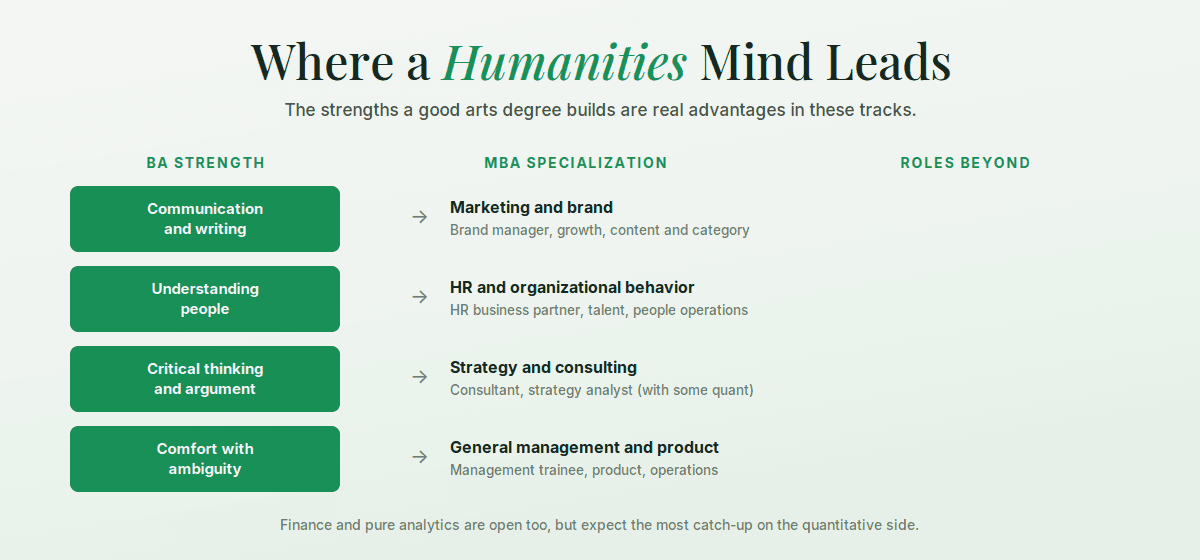
You can pick any specialization, but some let a humanities mind lead with its strengths while others ask you to compete on your weakest ground. The map below traces the strengths a BA builds to the tracks where they are genuine assets.
Marketing and brand: the natural home
The clearest fit. Marketing runs on understanding what people want, telling a story about a product, and communicating it well, which is a humanities graduate’s home ground. Brand management, growth, content strategy and category roles reward the instinct for people and language that an arts degree sharpens, and this is where many BA graduates do their best work.
Human resources and organizational behavior
If your degree was in psychology, sociology or anything that studied how people and groups behave, HR and organizational roles are a strong and often overlooked match. HR business partner, talent and people-operations roles are built on exactly the understanding of motivation and behavior a humanities education develops.
Strategy, consulting, and general management
Consulting and strategy prize structured thinking and the ability to make sense of a messy, open-ended problem and argue a way through it, which is what humanities training is. These paths do ask for more quantitative comfort, so they suit the arts graduate willing to close that gap deliberately. General management and product roles similarly reward the breadth and judgment a BA builds.
An honest steer on finance and analytics. Both are open to you, and some arts graduates thrive in them. But they are the tracks where you will do the most catch-up, competing directly with commerce and engineering peers on their strongest ground. Choose them because you genuinely want the quantitative work, not to prove you can, which is usually the wrong reason.
The Quant Gap, and How to Close It
This is the one real piece of work, so here it is in practical terms rather than as a vague warning.
What the entrance exams and the MBA core actually need is not advanced mathematics. It is a solid command of arithmetic, algebra, ratios and percentages, some geometry, and above all data interpretation, reading tables and charts and reasoning quickly with numbers. A BA graduate from a non-mathematical stream may be rusty on this, not incapable of it, and the distinction matters.
Closing the gap is a preparation task with a clear shape. Start earlier than a commerce graduate would, since you are rebuilding rather than refreshing. Work systematically through quantitative aptitude and data interpretation, the two sections that carry the most weight and reward practice the most. Sit timed mock tests to build speed, since the exam pressures pace as much as ability. And if the first year’s finance and statistics worry you, a short bridging course before the program turns an intimidating start into a manageable one. None of this is beyond a capable arts graduate; it simply needs to be started sooner and taken seriously.
MBA After BA as a Fresher, or After Work Experience?
Both routes work, and for a BA graduate the experience-first option often carries a particular advantage worth weighing.
Straight through, as a fresher
You attempt the entrance in your final year and go directly into an MBA. You keep your study momentum, finish younger and avoid the opportunity cost of waiting. The trade is that you enter with academics but little professional context, and you may choose a specialization before you have seen enough of working life to know what suits you.
A few years of work first
You take a role, in content, marketing, operations, an NGO, media or communications, for two to three years, then apply. For an arts graduate this often produces an unusually strong pivot story: you can show that you can operate in a business setting, which answers the exact doubt an admissions panel might otherwise have about a humanities background. It also sharpens your sense of which specialization fits. The cost is the delay and the discipline of going back to study.
As a rough guide: if your quantitative preparation is solid and you have a clear reason to go now, straight through is defensible. If you want to strengthen a humanities profile and remove any doubt about business readiness, a couple of years of relevant work does that more effectively than another entrance attempt.
Eligibility and Entrance Exams
The baseline is reassuringly open to an arts graduate.
Undergraduate score. Usually a minimum of 50 percent aggregate in your BA, with top-tier schools looking for 55 to 60 percent or higher. Your discipline does not count against you.
Entrance exams. CAT for the IIMs and most top Indian schools, with XAT, NMAT, SNAP and CMAT accepted widely, and the GMAT for study abroad or executive programs. All of them test aptitude rather than commerce knowledge, so a BA is not disadvantaged on subject matter.
Selection rounds. A group discussion, written ability test and personal interview, where a humanities graduate’s communication and argument often stand out.
No CAT score? You still have real options. Beyond the XAT, NMAT, SNAP and CMAT routes, some newer programs admit entirely on profile rather than a single exam, which can suit an arts graduate whose strengths show better in their work and thinking than in a timed quantitative test. Scaler School of Business, covered below, is one such route, no CAT or GMAT required.
Salaries and ROI After an MBA Following BA
An MBA can lift a BA graduate’s trajectory substantially, especially since many arts degrees lead to modest early salaries on their own. Treat the figures below as ranges that depend on the school, the role and your starting point, not as promises. The roles a BA to MBA path most naturally leads to look roughly like this.
Role | Indicative entry range (India) | Where it sits |
|---|---|---|
Marketing / brand manager | ~₹7–14 LPA | The natural humanities fit |
HR business partner | ~₹6–12 LPA | The people-and-behavior track |
Management consultant | ~₹8–16 LPA | For the structured thinker who adds quant |
Product / general management | ~₹8–16 LPA | Breadth and judgment roles |
Read these numbers carefully before you trust them. An average is inflated by a few large offers, so a reported median tells you far more about a typical graduate. A headline salary means little without the placement rate behind it. And the real payback only shows when you set total fees against a realistic median, not the brochure figure. Judged that way, a mid-tier program that places well in your target function will often beat a bigger name that does not.
A Build-First Alternative: Scaler School of Business
There is one more route that suits a particular kind of arts graduate: the one who is tired of being asked to prove on paper that they can operate in business, and would rather just show it. That is the idea behind Scaler School of Business, an 18-month, full-time, on-campus PGP in Management and Technology in Bengaluru, admitted on the strength of your profile with no CAT or GMAT.
For a humanities graduate this changes the terms in a useful way. Instead of spending two years arguing that your communication and people skills translate to business, you spend them putting those skills to work on real ventures, where an ability to understand customers and tell a story is a direct competitive advantage, not a line on a resume.
What that looks like for an arts graduate:
Your people and communication skills meet a real market. Students run a live Direct-to-Consumer challenge on real startup capital, where reading what customers actually want and positioning a product to them shows up as real sales and margins, not a line on a resume. For a humanities graduate, that turns "good with people" from a claim into a result.
Can These B-School Students Build a ₹50 Lakh Dropshipping Business
You close the technical gap by using it, not studying it. Rather than sit through theory, an arts graduate builds working AI products and uses the current AI toolset directly across the program, which is usually the fastest way for a non-technical background to turn into real fluency.
You work on real company problems. Company-sourced projects guided by industry leaders, hands-on go-to-market work with established consumer brands, and a full internship, so you graduate with a portfolio of real business problems solved rather than cases discussed.
You build inside a live ecosystem. The Scaler Innovation Lab sits on the same campus, with funded startups operating alongside class, so you work with and inside real ventures instead of observing them from a distance.
You learn from operators and backers who have built. SSB was co-founded by Anshuman Singh (formerly Meta) and Abhimanyu Saxena, both IIIT-Hyderabad alumni, and is backed by founders including Deepinder Goyal of Zomato and Kunal Shah of CRED, with faculty drawn from working operators.
It tends to fit the arts graduate who wants a career in product, marketing or a startup and would rather demonstrate capability than defend a non-commerce background; the strong candidate whose real work outshines a quantitative entrance score; and the aspiring founder who wants the practice and the network before building something of their own.
What SSB says upfront. It awards a PGP certificate, not a UGC degree, and sits outside the AICTE and UGC frameworks by design, which is what lets it rewrite the curriculum every year and staff it with operators. If you specifically need a recognized degree, say for a government role, or if your goal is deep technical finance, SSB will tell you plainly it is not the right fit. For an arts graduate who wants to build and lead on the strength of what they can do, that trade is often worth making. |

How to Decide: A BA Graduate’s Framework
Run your own situation through these, in order. They resolve most of the decision faster than another comparison will.
Where do your strengths sit, people or numbers? Communication and people steer you toward marketing, HR and general management; a genuine appetite for the quantitative steers you toward consulting, finance or analytics with more catch-up.
Are you ready to close the quant gap? Be honest about the preparation the entrance exam needs. If you will do the work, the door is open; if you will not, choose a specialization that leans on it less.
Fresher or experience-first? A couple of years of relevant work strengthens a humanities profile and removes any doubt about business readiness. Go straight through only if your preparation and reasons are already clear.
Do you want to argue your capability or demonstrate it? If you would rather show what you can build than defend a non-commerce background on paper, a build-first program may fit you better than a lecture-and-case MBA.
Do you need a recognized degree? If a government role or further academic study requires one, that rules some options in and others out. Settle it early.
Common Mistakes BA Graduates Make
Assuming you are underqualified and aiming too low. A humanities background is a valued profile, not a weakness; do not talk yourself out of strong programs before you start.
Choosing finance to prove you can do quant. That is usually the wrong reason. Pick a specialization because it fits your strengths, not to answer a doubt about them.
Underpreparing for the quantitative section. This is the one part that genuinely needs early, systematic work. Leaving it late is the most common avoidable mistake.
Hiding the arts background instead of using it. Your communication and people skills are a differentiator in interviews and on the job; lead with them rather than apologizing for them.
Choosing on brand alone. A recognizable name with a weak placement record in your target function is worse than a mid-tier school with strong outcomes in it.
Frequently Asked Questions
Q1. Can an arts student do an MBA?
A: Yes. MBA programs admit graduates of any discipline, and a humanities background is a valued profile, not a barrier. The one area to prepare for is the quantitative side of the entrance exam and the first-year core, which is a learnable preparation task rather than an obstacle.
Q2. Is a BA graduate at a disadvantage in an MBA?
A: Only on the quantitative side, and only at the start. Against that, a humanities background brings communication, critical thinking and an understanding of people that many quant-strong peers lack and that business increasingly rewards, so the net position is often an advantage once the quant gap is closed.
Q3. Which MBA specialization is best after BA?
A: Marketing and brand is the most natural fit, followed by HR and organizational roles for those with a psychology or sociology background. Strategy, consulting, general management and product also suit a humanities mind, especially one willing to build some quantitative comfort. Finance and pure analytics are open but require the most catch-up.
Q4. Can I do an MBA after BA without math?
A: Yes. You do not need a mathematics background, but the entrance exams do test quantitative aptitude and data interpretation, so you will need to prepare that section deliberately. It relies on arithmetic, algebra and reasoning with numbers rather than advanced mathematics.
Q5. Is the CAT hard for arts students?
A: The quantitative and data-interpretation sections take more preparation for a non-mathematical background, but the verbal and reading-comprehension sections often favor arts graduates. With early, systematic practice on the quant side, many arts students clear CAT every year.
Q6. Does an MBA after BA increase salary significantly?
A: It often produces a larger jump than for other streams, because several arts degrees lead to modest early salaries on their own. The size of the increase depends on the program’s placements and the role you target, so weigh the median package and placement rate rather than the headline average.
Q7. Should I do an MBA after BA or a master's in my subject?
A: They lead to different places. A master's in your subject deepens academic or specialist expertise and suits research, teaching or subject-specific careers. An MBA pivots you into business and management with broad career options. Choose the MBA if you want to move into the corporate or startup world, and the master's if you want to go deeper into your discipline.
The Bottom Line
An MBA after BA is a genuine and often powerful move, and the anxiety that usually precedes it, that an arts graduate is somehow not business material, does not survive contact with the facts. The thinking a good humanities degree builds is exactly what business increasingly needs; the only real work is closing the quantitative gap and choosing a specialization that lets your strengths lead rather than asking you to compete on your weakest ground.
So answer the strengths question first, take the quant preparation seriously, and be honest about whether you would rather argue your capability or demonstrate it. If it is the latter, a build-first option such as Scaler School of Business, where a humanities graduate’s people and communication strengths get applied to real ventures rather than described in an essay, is worth weighing on its own terms, as an alternative to a traditional MBA rather than a version of one.
Non-IIM MBA
Top Non-IIM MBA Colleges in Bangalore (2026): Fees, Placements & How to Choose
5 min. read
MBA for Professionals
Is an MBA Worth It for Working Professionals? An Honest 2026 Guide
5 min. read

MBA for Engineers
MBA After B.Tech (2026): Eligibility, Specializations, Salary & Is It Worth It?
5 min. read
MBA for Engineers
MBA After Engineering (2026): Eligibility, Specializations, Salary & Is It Worth It?
5 min. read