MBA for Non-Tech
MBA After BBA (2026): Is It Worth It, or Just More of the Same?
Explore whether an MBA after BBA is worth it or just repetition, how the two degrees differ, when to deepen or pivot through specialization, and how to choose between a traditional MBA and a build-first business route.
Team SSB
5 min. read

You already have a business degree. So the question in your head about an MBA after BBA is not the one the brochures answer. It is sharper and more specific: won’t an MBA just repeat what my BBA already taught me? You have already sat through accounting, marketing, organizational behavior and the rest, and the honest worry is that a master’s in the same subject is three more years of the same material at a higher price.
It is a fair worry, and most guides dodge it by calling BBA to MBA the “logical, smooth” next step, which quietly admits the overlap without addressing it. The truth is more useful. There is real overlap, but only at the start, and a good MBA operates at a level a BBA does not reach. Whether it is worth it for you comes down to one thing: using the head start your BBA gives you to go deeper, rather than coasting on the familiar. This guide works through the overlap honestly, what actually changes between the two degrees, the specialization strategy that fits a BBA graduate specifically, realistic salaries, and a build-first alternative for people who would rather apply what they know than study it again.
Short answer. An MBA after BBA is worth it when you want to move from knowing the business functions to leading them, and want the specialization depth, experienced peer group and managerial recruiting access a BBA cannot provide. The overlap with your BBA is real but brief, a runway, not the destination. The value is in the step-up in level and access, so the decision turns on whether you will use the head start to deepen or pivot, rather than repeat.
Won’t an MBA Just Repeat My BBA?
This is the question worth answering before any other, because it decides whether the rest of the decision is even worth making. The honest answer has two parts.
Yes, the first few months will feel familiar. The introductory finance, marketing and management your BBA covered will come around again early in an MBA. That is the overlap, and it is real. But it is the runway, not the flight. It is a head start that lets you move through the basics faster, not a preview of the whole program.
No, the program as a whole is a different thing. A BBA teaches you what the business functions are and how each one works. An MBA teaches you to make decisions across all of them at once, under pressure and with incomplete information, to lead teams rather than sit on them, and to go deep in a specialization rather than skim the surface of everything. It does this with a more experienced peer group, case-based and experiential rigor, and access to managerial roles that a BBA cohort is not recruited for. The subject overlaps; the level does not.
So the repetition worry is right about the first few weeks and wrong about the two years. The question is not whether an MBA covers new ground, it does, but whether you will use the familiar start to reach that ground faster, which is where the next sections come in.
BBA vs MBA: What Actually Changes
The clearest way to see past the overlap is to set the two degrees side by side on the things that actually differ. This is the comparison a BBA graduate needs and rarely gets.
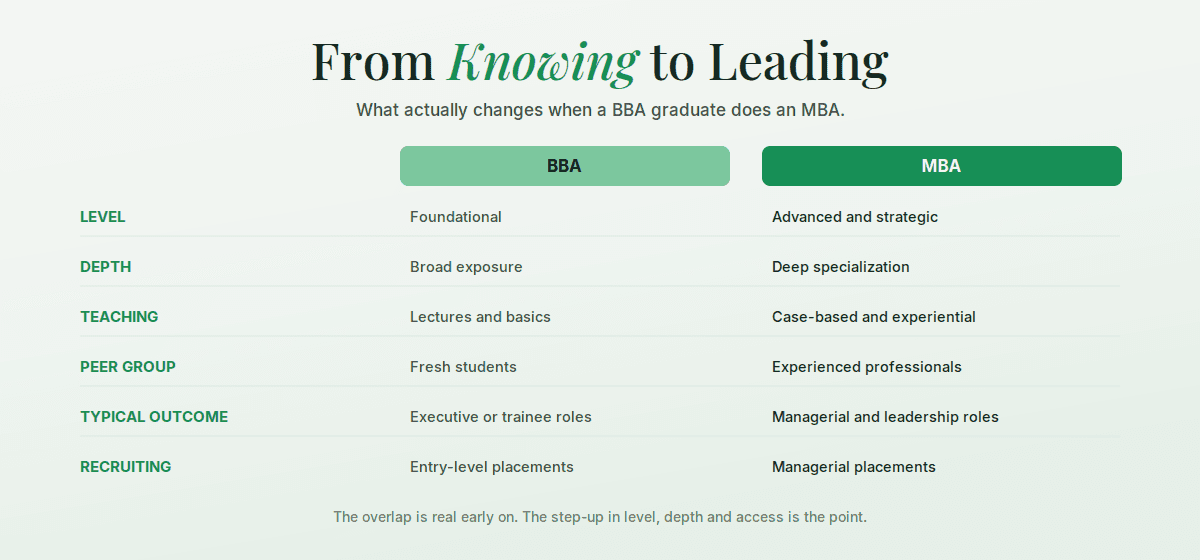
Read down that list and the pattern is consistent: the BBA gave you breadth at a foundational level and put you in line for executive and trainee roles; the MBA adds depth and strategic thinking, teaches through cases and real problems rather than lectures, surrounds you with people who have worked, and opens managerial placements. The two are not the same degree at different prices. They are different stages of a career, and the MBA is the one that moves you from doing the work to directing it.
The Real Benefit, and the Real Risk, of the Head Start
Most people think that a BBA graduate transitioning into an MBA is smooth. That is true, and it is genuinely useful, but it is only half the story, and the missing half is the part that decides whether the MBA pays off.
The benefit is real. Because you already understand the fundamentals, you will absorb the first-year core faster than classmates from engineering or arts backgrounds who are meeting finance and accounting for the first time. That is time and mental energy freed up, and it is a real advantage a BBA graduate starts with.
The risk is the one nobody mentions. That freed-up time is only an advantage if you spend it. The trap for a BBA graduate is coasting, treating the familiar early months as a victory lap and easing off, precisely when the head start should let you push harder into what is new: deeper specialization, leadership reps, networking, and the recruiting process. A BBA graduate who coasts converts a genuine advantage into a wasted one and ends up with an expensive repeat of their undergraduate degree, which is exactly the outcome the repetition worry feared. Used well, the head start is why a BBA graduate can get more out of an MBA than most; used lazily, it is why some get less.
Specialization Strategy for BBA Graduates: Deepen or Pivot
Here the BBA graduate’s move is different from other backgrounds. Because you already have broad business exposure, the smart play is not to acquire more breadth, you have that, but to make a deliberate choice between two directions.
Deepen
If your BBA showed you the function you want to build a career in, use the MBA to go deep in it and turn general familiarity into genuine expertise. A finance concentration takes you from having studied finance to being able to do corporate finance, investment analysis or FinTech work; a marketing concentration takes you from marketing basics to brand, growth or category leadership. Deepening is the right move when you already know your destination and want to become an expert in it rather than a generalist who has heard of everything.
Pivot
If your BBA convinced you that you want something beyond where the degree typically leads, use the MBA to change direction. Product management, strategy consulting, business analytics and entrepreneurship all sit beyond the usual BBA landing zone, and an MBA is one of the more reliable ways to move into them. Pivoting is the right move when the breadth of your BBA taught you what you do not want as much as what you do.
Either way, the deciding question is not which specialization is hottest, it is whether you are trying to go deeper in familiar ground or to move onto new ground. Answer that first, and the specialization follows.

MBA After BBA as a Fresher, or After Work Experience?
Both routes work, but the overlap between the degrees gives this decision a particular weight for a BBA graduate.
Straight through, as a fresher
You attempt the entrance in your final year and go directly into an MBA. You keep your momentum and finish younger. The specific risk for a BBA graduate is that, with no working experience in between, the MBA can feel more like a fifth and sixth year of business school than a genuine step change, and the overlap is felt more sharply. It works best if you have a clear specialization goal that gives the MBA a distinct purpose.
A few years of work first
You take a role for two to three years, then apply. For a BBA graduate this is often what turns the MBA from a continuation into a genuine step-up: working experience gives the case discussions real weight, clarifies the deepen-or-pivot decision, and puts you among the experienced peers who make the program what it is. The cost is the delay and the discipline of returning to study.
As a rough guide: with a clear specialization goal and a strong reason to go now, straight through is defensible. If the overlap worry is what brought you here in the first place, a couple of years of work is the surest way to make sure the MBA feels like the next stage rather than a repeat of the last one.
Eligibility and Entrance Exams
The baseline is straightforward, and a BBA graduate carries a mild edge into parts of it.
Undergraduate score. Usually a minimum of 50 percent aggregate in your BBA, with top-tier schools expecting 55 to 60 percent or higher.
Entrance exams. CAT for the IIMs and most top Indian schools, with XAT, NMAT, SNAP and CMAT accepted widely, and the GMAT for study abroad or executive programs. A BBA background can help with the business-context reasoning in some sections, though the quantitative and verbal aptitude still needs its own preparation.
Selection rounds. A group discussion, written ability test and personal interview, where familiarity with business fundamentals can help you contribute with more confidence.
No CAT score? You still have real options. Beyond the XAT, NMAT, SNAP and CMAT routes, some newer programs admit entirely on profile rather than a single exam. Scaler School of Business, covered below, is one such route, no CAT or GMAT required, which can suit a BBA graduate whose real strength is what they can do rather than a timed test score.
Salaries and ROI After an MBA Following BBA
Because you already hold a business degree, the ROI question is sharper for a BBA graduate than for most: the honest test is not whether an MBA pays, but whether it pays enough on top of what a BBA already earns you to justify the cost. The commonly quoted figure is that an MBA lifts starting salary by roughly 35 to 55 percent over a BBA alone. Treat that as directional, not a promise, it is real at strong programs and thin at weak ones, and it depends heavily on the specialization and the role.
Role | Indicative entry range (India) | Where it sits |
|---|---|---|
Finance manager / analyst | ~₹6–14 LPA | The deepen-in-finance path |
Business / data analyst | ~₹8–16 LPA | The analytics pivot |
Marketing / brand manager | ~₹7–14 LPA | Deepen or pivot into marketing |
Product / consulting | ~₹8–18 LPA | The pivot beyond a typical BBA role |
Read these numbers carefully before you trust them. A reported median tells you more about a typical graduate than an average inflated by a few large offers. A headline salary means little without the placement rate behind it. And the real payback only appears when total fees are set against a realistic median, not the brochure figure. Since you already hold a business degree, apply one extra test the others do not need: is the program's outcome worth the marginal cost over what a BBA alone would already earn you?
A Build-First Alternative: Scaler School of Business
If the worry that brought you here is repetition, there is one route that answers it more directly than any traditional MBA can: a program built not to teach you business again, but to have you do it. That is the idea behind Scaler School of Business, an 18-month, full-time, on-campus PGP in Management and Technology in Bengaluru, admitted on the strength of your profile with no CAT or GMAT.
For a BBA graduate the appeal is specific. You already have the theory your degree gave you. What you may not have had is a place to apply it on something real, with consequences, rather than in another set of lectures. SSB is built around exactly that, which is close to the opposite of the repetition a second business degree can feel like.
What that looks like for a BBA graduate:
You put the theory to work, not through it again. Students run a live Direct-to-Consumer challenge on real startup capital, where the marketing and finance your BBA already covered meet an actual market, with real sales, margins and consequences, instead of another exam paper.
Can These B-School Students Build a ₹50 Lakh Dropshipping Business
You build and ship real products. Where a BBA teaches the functions in theory, here you build working AI products and use the current AI toolset directly, adding the technical fluency a general business degree rarely provides and that managerial roles increasingly expect.
You work on real company problems. Company-sourced projects guided by industry leaders, hands-on go-to-market work with established consumer brands, and a full internship, so you leave with a record of business problems actually solved, not just analyzed in a case.
You build inside a live ecosystem. The Scaler Innovation Lab sits on the same campus, with funded startups operating alongside class, so you work with and inside real ventures rather than observing them from a distance.
You learn from operators and backers who have built. SSB was co-founded by Anshuman Singh (formerly Meta) and Abhimanyu Saxena, both IIIT-Hyderabad alumni, and is backed by founders including Deepinder Goyal of Zomato and Kunal Shah of CRED, with faculty drawn from working operators.
It tends to fit the BBA graduate who has had enough of studying business and wants to operate it; the one aiming to pivot into product, a startup or a build-heavy role rather than a conventional managerial track; and the aspiring founder who wants to apply what a BBA taught on something of their own.
What SSB says upfront. It awards a PGP certificate, not a UGC degree, and sits outside the AICTE and UGC frameworks by design, which is what lets it rewrite the curriculum every year and staff it with operators. If you specifically need a recognized degree, say for a government role, or you want the conventional managerial-MBA route, SSB will tell you plainly it is not the right fit. For a BBA graduate who wants to finally apply their business knowledge rather than repeat it, that trade is often worth making. |

How to Decide: A BBA Graduate’s Framework
Run your own situation through these, in order. They settle most of the decision faster than another comparison will.
Deepen or pivot? If you know the function you want, use the MBA to go deep in it. If your BBA showed you that you want something else, use it to change direction. Decide this before you pick a specialization.
Will you use the head start, or coast on it? Be honest. The familiar early months are only an advantage if you spend the freed-up time going deeper, not easing off.
Fresher or experience-first? Given the overlap, a couple of years of work is often what makes the MBA feel like a step-up rather than a repeat. Go straight through only with a clear specialization goal.
Do you want more theory, or to apply what you have? If it is the latter, a build-first program answers the repetition worry more directly than a second lecture-based degree.
Do you need a recognized degree? If a government role or further study requires one, that rules some options in and others out. Settle it early.
Common Mistakes BBA Graduates Make
Doing the MBA on autopilot. Choosing it because it is “the logical next step” without a specialization goal is how the overlap worry comes true. Aim it at a deepen-or-pivot decision.
Coasting on the familiar start. The head start is an advantage only if you spend it going deeper, not easing off.
Staying a generalist. You already have breadth; repeating it wastes the MBA. Deepen into a function or pivot to a new one.
Assuming it will be easy throughout. The overlap is early and brief; the specialization core and the pace of a good MBA are not.
Choosing on brand alone. A recognizable name with a weak placement record in your target function is worse than a mid-tier school with strong outcomes in it.
Frequently Asked Questions
Q1. Is an MBA after BBA worth it, or is it just repetitive?
A: It is worth it when you use it to deepen a specialization or pivot to a new field, rather than repeat your degree. The overlap with a BBA is real but brief, limited to the introductory core, while the MBA as a whole operates at a higher level, with deeper specialization, an experienced peer group and managerial recruiting a BBA does not offer.
Q2. What is the actual difference between a BBA and an MBA?
A: A BBA is foundational and broad and leads to executive or trainee roles; an MBA is advanced and specialized, teaches through cases and real problems rather than lectures, surrounds you with experienced professionals, and opens managerial and leadership placements. The subjects overlap, but the level, depth and access do not.
Q3. Should I do an MBA right after BBA or work first?
A: Both work, but because the degrees overlap, a couple of years of work often makes the MBA feel like a genuine step-up rather than a continuation of undergraduate study. Going straight through is defensible if you have a clear specialization goal that gives the MBA a distinct purpose.
Q4. Do BBA graduates have an advantage in an MBA?
A: Yes, a real but temporary one. You will absorb the first-year fundamentals faster than classmates meeting them for the first time. The advantage only pays off if you spend the freed-up time going deeper rather than coasting on the familiar early months.
Q5. Which MBA specialization is best after BBA?
A: There is no single best; the right move is to decide whether you want to deepen or pivot. Deepen in a function your BBA showed you that you want, such as finance or marketing, or pivot toward product, consulting, analytics or entrepreneurship if you want to move beyond where a BBA typically leads.
Q6. Does an MBA after BBA really increase salary by 35 to 55 percent?
A: That figure is directional rather than guaranteed. A strong program in a well-chosen specialization can produce a jump in that range, while a weak program produces much less. Because you already hold a business degree, judge the increase against what a BBA alone would earn you, and weigh the median package and placement rate, not the headline average.
Q7. Can I do an MBA after BBA without CAT?
A: Yes. Many schools accept XAT, NMAT, SNAP or CMAT instead of CAT, and some newer programs, including Scaler School of Business, admit entirely on a profile-based evaluation with no entrance exam at all.
The Bottom Line
An MBA after BBA is not a repeat of your degree, unless you let it be. The overlap is real but confined to the opening months; past that, the MBA operates at a level a BBA does not, in depth of specialization, in the caliber of your peers, and in the roles it opens. The repetition worry is answered not by the program alone but by how you use it: to deepen into a function or pivot to a new one, spending the head start rather than coasting on it.
So decide to deepen or pivot first, be honest about whether you will use the advantage the familiarity gives you, and ask whether you want more theory or the chance to apply what you already have. If it is the latter, a build-first option such as Scaler School of Business, where a BBA graduate applies their business knowledge to real ventures rather than revisiting it in lectures, is worth weighing on its own terms, as an alternative to a traditional MBA rather than a second helping of one.

Non-IIM MBA
Top Non-IIM MBA Colleges in Bangalore (2026): Fees, Placements & How to Choose
5 min. read

MBA for Professionals
Is an MBA Worth It for Working Professionals? An Honest 2026 Guide
5 min. read

MBA for Engineers
MBA After B.Tech (2026): Eligibility, Specializations, Salary & Is It Worth It?
5 min. read

MBA for Engineers
MBA After Engineering (2026): Eligibility, Specializations, Salary & Is It Worth It?
5 min. read