Business Management Glossary
Scope of Management: How Far the Discipline Actually Reaches Decision
Understand the scope of management, including the functional areas it covers, why management applies across every level and type of organization, and how it connects work, people, operations and information into one discipline.
Team SSB
5 min. read

The scope of management is the full range of areas and activities that management as a discipline reaches across. Where one question asks what managers do and another asks who holds authority, scope asks how far management extends: across which parts of an organization, at which levels, and in which kinds of enterprise.
The short answer is that it extends almost everywhere. Management is not confined to one department, one rank or one sector; it applies across every functional area of an organization, at every level of its hierarchy, and in businesses, governments and nonprofits alike. This entry maps that reach, the functional areas, the universality and the boundaries, and points to separate entries for the management process and the levels, which are their own topics.
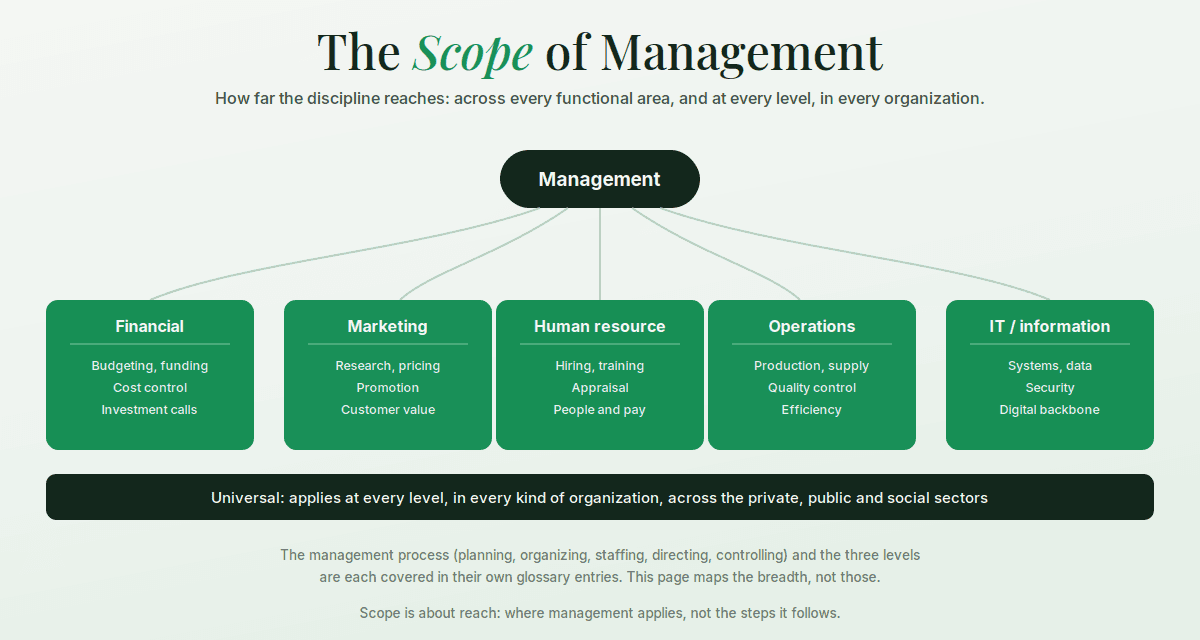
Short answer. The scope of management covers every functional area of an organization, financial, marketing, human resource, production and operations, and information technology management, and it is universal: it applies at every level of the hierarchy and in every kind of organization, private, public or social. Management is also multidimensional, covering work, people and operations at once. Its scope is best understood as reach, how far management applies, rather than the steps of the management process or the three levels, which are separate topics. |
The Functional Areas Management Covers
The clearest way to see the breadth of management is by its functional areas: the specialized domains of an organization, each of which is managed. The same management discipline applies in each, adapted to that area's work. This is the heart of the scope, so it carries the most detail here.
Financial management
Financial management applies management to a firm's money: planning and raising funds, budgeting, controlling costs, and deciding where capital is invested. Its aim is to keep the organization financially healthy and to put its funds to their most productive use, from estimating capital needs to examining financial statements and staying compliant. Every organization that handles money has a version of it.
Marketing management
Marketing management covers everything involved in understanding customers and delivering value to them: market research, product decisions, pricing, promotion and the channels that reach buyers. It runs from identifying what customers want to planning and controlling the campaigns that meet that want, whether through traditional or digital means. It is the functional area that faces the market.
Human resource management
Human resource management applies management to people, an organization's staff. It spans workforce planning, recruitment and selection, training and development, performance appraisal, compensation, and the day-to-day work of keeping a productive, fairly treated workforce. Because every organization runs on people, this area is close to universal.
Production and operations management
Production and operations management covers the work of turning inputs into the goods or services an organization delivers: planning and scheduling production, procuring materials, allocating labor, controlling quality, and improving efficiency. In a manufacturer it governs the factory; in a service firm it governs how the service is produced and delivered. It is where the core work of the enterprise actually happens.
Information technology and information management
As organizations run increasingly on data and systems, information technology management has become a functional area in its own right: managing the digital infrastructure, data and security that the rest of the business depends on, and aligning technology with the organization's wider aims. It is the newest of the standard areas and, in many firms, now among the most important.
These are the standard areas, but the list is not rigid. Larger or more specialized organizations add areas, supply chain, risk, project, quality, that are really further applications of the same management discipline to a distinct slice of work. The point of the scope is that wherever a distinct domain of organized activity exists, management reaches into it.
Management Is Universal: Every Level, Every Organization
The functional areas describe scope across an organization's work. A second axis describes scope across levels and across kinds of organization, and it is what makes management a genuinely universal activity rather than a business-only one.
Across every level. Management is practiced at the top, the middle and the frontline, not only in the corner office. A chief executive and a shift supervisor are both managing; what differs is the scale and horizon of what they manage, not whether they manage. The tiers themselves are a separate topic, covered in our guide on the levels of management.
Across every kind of organization. Management applies in a private company, a government department, a hospital, a school, a nonprofit and a sports team alike. Any group of people pursuing a shared goal with limited resources needs managing, which is why the discipline is taught as general rather than tied to one sector.
Across every scale. A single-owner shop and a multinational both practice management; the small firm simply holds many functional areas in one or two people, while the large one spreads them across specialized departments. Scope does not disappear at a small scale; it concentrates.
This universality is one of the defining characteristics of management as a discipline, discussed further in our article on the nature of management. For scope, the takeaway is simple: management is not a niche of business but a general way of getting organized work done, wherever that work happens.
Management Is Multidimensional
Scope also has a third sense: within any one area or level, management works on more than one thing at once. It manages work and operations, getting the actual tasks of the enterprise done, and it manages people, coordinating and motivating those who do the work. In a modern organization it increasingly manages a third dimension too: the flow of information and knowledge that ties the other two together. A production manager, for instance, is at the same time managing a process, a team and a stream of data about both. This is why management cannot be reduced to a single activity; its scope is wide even inside a single role.
What the Scope of Management Is Not
Because the scope is broad, it is easy to fold two neighboring ideas into it that are really their own topics. Keeping them separate is what makes the scope clear.
It is not the management process. The steps of managing, planning, organizing, staffing, directing and controlling, are the functions of management, a distinct topic. Scope is about where management applies; the functions are about the process it follows within each of those places. This entry references the functions but does not re-teach them.
It is not the levels of management. The vertical tiers, top, middle and frontline, are the levels of management. Scope includes the fact that management spans all the levels, but the tiers themselves, their roles and how authority moves between them, are covered in that separate entry.
One Company, Seen Through the Full Scope
The breadth is easiest to grasp on a single enterprise. Take a mid-sized company that makes and sells packaged foods, and follow the scope through it.
Across the functional areas. Finance is managing the budgets and capital; marketing is managing research, pricing and promotion; human resource management is running hiring and appraisal; operations is managing the factory and quality; and IT is managing the systems that connect them. One discipline, five distinct domains, all being managed at once.
Across the levels. The same functions of management are performed at every tier: the board plans the company's direction, a plant head plans the year's output, and a shift supervisor plans the day, each managing at their own scale.
Across the dimensions. Inside operations alone, the manager is running a process, leading a team and reading a stream of production data, all three dimensions in one role.
The point. No single corner of this company sits outside management's reach. That total reach, across areas, levels and dimensions, is precisely what the scope of management names.
Terms People Often Mix Up
Scope and functions of management
Scope is how far management reaches, across areas, levels and organizations. Functions are the process it follows, planning, organizing, staffing, directing, controlling, within each of those places. Scope is the map; functions are the method.
Scope and nature of management
Nature asks what kind of thing management is, a science, an art, a profession, and lists its characteristics. Scope asks how widely it applies. The two are often taught together as “nature and scope,” but they answer different questions.
Functional areas and functions
Functional areas are the domains management is applied to, finance, marketing, HR, operations, IT. Functions are the managerial steps applied inside each area. The words look alike but one is a place and the other is an activity.
Scope of management and project scope management
The scope of management is the reach of the management discipline. Project scope management is a narrow, specific practice within project management, defining exactly what a single project will and will not deliver. Search results often blur the two; they are different in size and in kind.
Learning the Whole Scope by Working Across It
Because management reaches across every functional area, understanding it fully means seeing how the areas connect, how a pricing call touches finance, how a hiring plan touches operations, rather than studying each in a silo. That cross-functional feel is hard to build from separate subjects and usually comes only from running something whole.
That is the design behind Scaler School of Business. Its 18-month, full-time program in Bengaluru has student teams run real ventures where they own finance, marketing, people and operations decisions together on the same business, so the breadth of management is experienced as one connected job rather than a list of separate functional areas.
Selection weighs your profile rather than a single exam score, and the award is a PGP certificate in management and technology, taught full-time on campus rather than as a conventional degree. It fits people who want to learn the whole scope of management by carrying it, not just reading about its parts.

Frequently Asked Questions
Q1. What is the scope of management?
A: The scope of management is the full range of areas and activities the discipline reaches across. It covers every functional area of an organization, finance, marketing, human resource, operations, and IT, applies at every level of the hierarchy, and works in every kind of organization, private, public or social. In short, it describes how far management extends rather than the steps it follows.
Q2. What are the functional areas of management?
A: The standard functional areas are financial management, marketing management, human resource management, production and operations management, and information technology management. Larger organizations add areas like supply chain, risk, project and quality management, which are further applications of the same discipline to a distinct domain of work.
Q3. Is management universal?
A: Yes. Management is practiced at every level of an organization and in every kind of organization, businesses, governments, hospitals, schools and nonprofits, because any group pursuing a shared goal with limited resources needs managing. This universality is why management is taught as a general discipline rather than one tied to a single sector.
Q4. What is the difference between the scope and functions of management?
A: Scope is how far management reaches, across functional areas, levels and organizations. Functions are the process it follows, planning, organizing, staffing, directing and controlling, within each of those places. Scope is the map of where management applies; functions are the method it uses once there. They are complementary but distinct topics.
Q5. What is the difference between the scope and nature of management?
A: The nature of management asks what kind of thing management is, whether it is a science, an art or a profession, and describes its characteristics. The scope of management asks how widely it applies. They are often taught together as “nature and scope,” but nature is about what management is and scope is about how far it reaches.
Q6. Does the scope of management change with the size of the organization?
A: The reach is the same, but how it is spread differs. A small business holds several functional areas in one or two people, while a large one splits them across specialized departments. Management does not disappear at small scale; it concentrates in fewer hands, and expands into more specialized roles as the organization grows.
Q7. Is the scope of management the same as project scope management?
A: No. The scope of management is the broad reach of the management discipline across areas, levels and organizations. Project scope management is a narrow practice within project management that defines exactly what a single project will and will not deliver. Search results sometimes blur them, but they differ in both size and kind.
Q8. Why is management called multidimensional?
A: Because within any single area or role, management works on more than one thing at once: it manages the work and operations, it manages the people doing that work, and increasingly it manages the information that connects them. A single manager is often running a process, leading a team and reading data about both at the same time, which is why management cannot be reduced to one activity.

Non-IIM MBA
Top Non-IIM MBA Colleges in Bangalore (2026): Fees, Placements & How to Choose
5 min. read

MBA for Professionals
Is an MBA Worth It for Working Professionals? An Honest 2026 Guide
5 min. read

MBA for Engineers
MBA After B.Tech (2026): Eligibility, Specializations, Salary & Is It Worth It?
5 min. read

MBA for Engineers
MBA After Engineering (2026): Eligibility, Specializations, Salary & Is It Worth It?
5 min. read