Business Management Glossary
Types of Planning in Management: Why the Count Never Agrees
Understand the main types of planning in management, including strategic, tactical and operational plans, single-use and standing plans, functional planning, and how each type helps managers turn goals into action.
Team SSB
5 min. read

Planning is deciding in advance what to do, how to do it, and who will do it, before any action is taken. It is the first function of management, examined in full in our entry on the functions of management. The word "type" is where the confusion starts, because it gets used for three different things at once: the level a plan sits at, how often it is reused, and what part of the business it concerns. Once those are separated, the varieties fall into a clear order, which is how this entry is arranged.
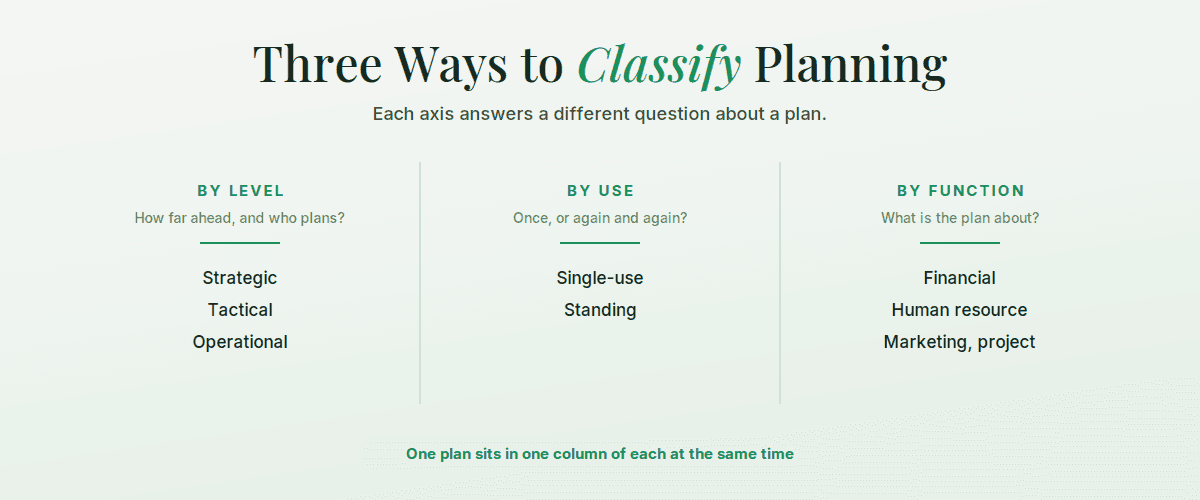
Short answer. Plans are classified three ways. By level, they are strategic (long-term, set by top management), tactical (medium-term, set by middle management) or operational (short-term, set by supervisors). By use, they are single-use (made for one objective) or standing (used repeatedly). By function, they are named for the area they cover, such as financial, marketing or human resource planning. A single plan belongs to one category in each of the three. |
The Three Ways Planning Is Classified
Plans are grouped along three independent dimensions, and each one answers a different question.
By level. How far ahead does the plan look, and who makes it? This separates strategic from tactical from operational planning, and it maps onto the levels of management.
By use. Is the plan made for a single occasion or used again and again? This separates single-use plans from standing plans.
By function. What part of the business does the plan concern? This names a plan for its subject: financial, marketing, human resource, production or project planning.
A single plan holds a position on all three axes at once. A one-year budget for a marketing department is operational in level, single-use in reuse, and financial in function, and all three descriptions are correct together. A plan therefore has more than one correct name depending on which axis is being used to describe it, which is what makes a flat list of planning types misleading. The sections below take each axis in turn.
Planning by Level: Strategic, Tactical and Operational
The most common classification follows the level of the organization that does the planning. The three tiers correspond to the levels of management, and they differ in how far ahead they look and how broad they are.
Strategic planning
Strategic planning sets the direction of the whole organization over the long term, usually three to five years or more. It is done by top management and answers the largest questions: what the organization is trying to become, which markets it will compete in, and where it will invest. Strategic plans are broad rather than detailed, because they set the destination and leave the route to the levels below.
Tactical planning
Tactical planning translates the strategy into what each department or division will do, usually over one to three years. It is done by middle management, and it is more specific than strategic planning: concrete targets, resource allocations and budgets for a particular function. If the strategy is to enter a new region, the tactical plan is how the marketing, supply and operations departments will each contribute to that entry.
Operational planning
Operational planning covers the day-to-day work that carries out the tactical plans, over the short term, from a single day up to a year. It is done by supervisors and frontline managers, and it is the most detailed of the three: schedules, task assignments, quality standards and output targets. Operational plans are what most people are actually doing on any given day.
The three nest inside one another. An operational plan completes a piece of a tactical plan, and the tactical plans together complete the strategic plan. Read the other way, the strategy sets the goal, tactics divide it among departments, and operations turn each department’s share into scheduled work. The distribution of planning across the levels is covered from the hierarchy’s point of view in our entry on the levels of management.
Level | Horizon | Who plans it | Scope |
|---|---|---|---|
Strategic | 3 to 5+ years | Top management | The whole organization |
Tactical | 1 to 3 years | Middle management | A department or division |
Operational | Daily to 1 year | Supervisors | Specific tasks and routines |
The Three Levels Applied to One Goal
The levels are easiest to see when a single goal is carried down through all three. Take a mid-sized coffee retailer whose owners decide to grow the business.
Strategic. Top management sets the direction: become the leading regional chain within five years by opening in ten new cities. The plan names the goal, the timeframe and the broad approach, and stops there.
Tactical. Middle managers turn that into departmental plans for the next year: the property team plans to secure fifteen sites, marketing plans the launch campaign for the first three cities, and operations plans for the supply chain that will serve them. Each is a one-year plan for one function, sized to its share of the strategy.
Operational. Supervisors plan the details for the store opening this month: the staff rota for opening week, the daily stock orders, the training schedule for new baristas, and the checklist that has to be completed before the doors open. These plans run from a day to a few weeks.
One goal, three plans, each a different size and horizon, and each depending on the one above it. The store rota means nothing without the city launch it serves, and the city launch means nothing without the five-year goal it advances. That dependency is the whole point of classifying plans by level.
Planning by Use: Single-Use and Standing Plans
The second axis is how often a plan is used. Some plans are made for one occasion and then set aside; others are made once and used repeatedly whenever the same situation recurs.
Single-use plans
A single-use plan is made for one specific objective and discarded once that objective is met. A plan to open one new store, the budget for a particular quarter, or a program to migrate to new software are all single-use: each exists for its own occasion and has no further purpose once complete. Programs, projects and budgets are the usual forms.
Standing plans
A standing plan is made once and used again and again, so that a recurring situation does not have to be thought through from scratch each time. Standing plans come in four forms, from the broadest to the most specific.
Policies are broad guides to thinking that set the boundaries within which decisions are made, such as a policy of promoting from within where possible. They guide judgment rather than dictate it.
Procedures are fixed sequences of steps for carrying out a recurring activity, such as the steps for processing a refund. They specify the order, not just the goal.
Methods describe how one step within a procedure is to be performed, standardizing the way a single task is done.
Rules are exact statements of what must or must not be done, with no room for judgment, such as a no-smoking rule. A rule is the most rigid standing plan.
Planning by Function: What the Plan Is About
The third axis simply names a plan for the area of the business it covers. These are not a separate hierarchy; they are the same plans described by subject rather than by level or use. The common ones are financial planning (budgets, funding and cash), human resource planning (staffing, hiring and training), marketing planning (positioning, campaigns and channels), production or operations planning (output, capacity and scheduling), and project planning (a defined piece of work with a start and an end). A single marketing campaign plan is functional by subject, tactical by level and single-use by use, all at once.
Where Contingency Planning Fits
Contingency planning is frequently listed as a fourth item next to strategic, tactical and operational, but it belongs on a different axis. Those three describe the level a plan sits at; contingency planning describes a plan’s relationship to uncertainty. A contingency plan is a prepared response to a situation that may or may not happen, a supply failure, a data breach, a sudden drop in demand, held ready so the organization can act quickly if it does. Contingency plans exist at every level: a strategic contingency for losing a major market, an operational one for a key supplier missing a delivery.
The same axis holds two related terms. Proactive planning anticipates change and prepares for it before it arrives; reactive planning responds to change after it has already happened. Contingency planning is a form of proactive planning, since it prepares the response in advance rather than improvising once the disruption is underway.
Terms People Often Mix Up
Strategic and tactical planning
Strategic planning sets the long-term goal for the whole organization; tactical planning works out how a department will help reach it over the next year or so. Strategy is the what and the why, tactics are the how and the who. The clearest signal is the horizon: years for strategy, a year or less for tactics.
Policy, procedure and rule
All three are standing plans, but they differ in how much judgment they allow. A policy guides a decision without making it. A procedure fixes the sequence of steps. A rule removes judgment entirely, stating exactly what must or must not happen. They run from most flexible to least.
Single-use and standing plans
A single-use plan is spent once its objective is met; a standing plan is reused every time the situation recurs. A project to launch a product is single-use; the procedure for handling customer complaints is standing.
Planning and a plan
Planning is the activity, the ongoing work of deciding in advance. A plan is the output, the specific document or decision that results. One is the verb, the other the noun, which is why planning is a function of management while a plan is a thing that function produces.
Forecasting and planning
Forecasting estimates what future conditions will be; planning decides what to do about them. A forecast is an input to planning, not planning itself. A sales forecast predicts demand; the plan decides how much to produce in response.
Planning at Three Levels, on a Real Deadline
Planning across the three levels is straightforward to list and harder to feel. Writing a strategic target, breaking it into a department’s tactical plan, and then running the week’s operational schedule against it is a different experience when the plan is real and the deadline is fixed, because the levels stop being tidy and start competing for the same time and money.
Scaler School of Business is built around that kind of work. It runs an 18-month, full-time PGP in Management and Technology in Bengaluru, admitted on the strength of your profile with no CAT or GMAT. Student teams run real ventures on real capital, including a launch challenge where a team plans a product from strategy down to the day's tasks and executes it within a fixed window. The nesting of strategic, tactical and operational planning stops being a diagram and becomes something they actually do.
The credential is a PGP certificate, not a UGC degree, earned through an 18-month, full-time program on campus.

Frequently Asked Questions
Q1. How many types of planning are there?
A: There is no single number, because plans are classified on three separate axes: by level (three types), by use (two types), and by function (as many as the business has areas). Lists that give four, seven or eight are combining positions from different axes into one sequence.
Q2. What are the 4 types of planning?
A: The four most often listed are strategic, tactical, operational and contingency planning. The first three are levels; contingency planning sits on a different axis, describing preparation for uncertainty rather than a level in the hierarchy.
Q3. Which type of planning comes first?
A: Strategic planning, because it sets the goal that the others work toward. Tactical planning follows from it, and operational planning follows from tactical, so the sequence runs from the top of the organization downward.
Q4. Who is responsible for each type of planning?
A: Top management does strategic planning, middle management does tactical planning, and supervisors and frontline managers do operational planning. Contingency and functional plans are made at whichever level the situation calls for.
Q5. What is the difference between a single-use and a standing plan?
A: A single-use plan is made for one objective and discarded once it is met, such as a project or a one-time budget. A standing plan is made once and reused whenever the same situation recurs, such as a policy, procedure or rule.
Q6. Is contingency planning the same as risk management?
A: They overlap but are not identical. Risk management is the broader process of identifying and reducing risks; a contingency plan is one output of it, a prepared response for a specific disruption if it occurs.
Q7. Can a small business use all these types?
A: Yes, though less formally. A small business still sets a direction, plans the year, and organizes the week, and it still has policies and one-off projects, even if one person does all of it without labeling each plan by type.
Q8. What are the parts of a plan?
A: A complete plan usually contains objectives, the forecasts it rests on, the policies and procedures that guide it, the programs or projects that carry it out, and the budget that funds it. These are the components, distinct from the types of plan described above.

Non-IIM MBA
Top Non-IIM MBA Colleges in Bangalore (2026): Fees, Placements & How to Choose
5 min. read

MBA for Professionals
Is an MBA Worth It for Working Professionals? An Honest 2026 Guide
5 min. read

MBA for Engineers
MBA After B.Tech (2026): Eligibility, Specializations, Salary & Is It Worth It?
5 min. read

MBA for Engineers
MBA After Engineering (2026): Eligibility, Specializations, Salary & Is It Worth It?
5 min. read