Business Management Glossary
Working Capital Management: Components, Ratios and Why It Matters
Understand working capital management, including its key components, ratios, cash conversion cycle, and how businesses balance liquidity with profitability while managing receivables, inventory, payables and cash.
Team SSB
5 min. read

A business can close a strong, profitable year and still run out of cash. Orders are up, margins are healthy, the income statement looks good — and the company still can't pay its suppliers on time, because the profit is sitting in unpaid invoices and unsold stock rather than in the bank. Working capital is what that gap is made of: the money tied up in day-to-day operations, what a business is owed and what it holds in stock and cash, less what it owes in the short term. Working capital management is the practice of keeping that balance healthy, so the business can always pay its bills without leaving cash idle that could be put to work.
This entry covers what working capital is made of, the ratios used to measure it, the cash conversion cycle that ties them together, the trade-off between safety and return that sits at the center of the subject, and how banks in India assess a business's working capital needs.
Short answer. Working capital management is the management of a company’s current assets and current liabilities, receivables, inventory, payables and cash, so that it can meet its short-term obligations while using as little idle cash as possible. Its central aim is to balance liquidity, the ability to pay bills, against profitability, since cash held for safety earns nothing. |
What Working Capital Is
Working capital is the difference between a company’s current assets and its current liabilities, the items on the balance sheet that turn into, or must be paid in, cash within a year (Investopedia).
Current assets are what the business owns that will become cash within the year: cash itself, marketable securities, accounts receivable (money owed by customers), and inventory (raw materials, work in progress and finished goods). Current liabilities are what it must pay within the year: accounts payable (money owed to suppliers), short-term debt, and accrued expenses such as wages and taxes not yet paid.
Two distinctions matter. Gross working capital refers to the total of current assets, while net working capital is current assets minus current liabilities, which is the figure most people mean by the term. Separately, permanent working capital is the minimum level the business always needs to keep running, and temporary or fluctuating working capital is the extra required to meet seasonal or cyclical peaks, such as a retailer stocking up before a festival.
What Working Capital Management Involves
Managing working capital means managing four things at once, each a lever on how much cash the business has free at any moment.
Receivables. The money customers owe. Collecting it faster, through clear credit terms, prompt invoicing and firm follow-up, brings cash in sooner, though credit that is too tight can cost sales.
Inventory. The stock held. Holding less frees cash and cuts storage and obsolescence costs, but holding too little risks running out and losing sales. The balance is the point.
Payables. The money owed to suppliers. Paying later keeps cash in the business longer, which is effectively free financing, as long as it does not breach terms or strain the supplier relationship.
Cash. The buffer itself. Enough to meet obligations and absorb surprises, without so much sitting idle that it drags on returns.
The first three of these are what the ratios below measure, and together they determine how long the business waits between paying for something and getting paid for it.
The Key Ratios, Worked Through One Company
The measures of working capital are clearest when run on a single set of numbers. Take a small trading company with these figures for the year: current assets of ₹80 lakh, current liabilities of ₹50 lakh, of which cash and receivables are ₹45 lakh; annual revenue of ₹360 lakh; cost of goods sold of ₹270 lakh; average inventory of ₹45 lakh; average receivables of ₹40 lakh; and average payables of ₹30 lakh.
Current ratio and quick ratio
The current ratio is current assets divided by current liabilities: ₹80 lakh over ₹50 lakh gives 1.6. It shows the business holds 1.6 times the current assets needed to cover its short-term liabilities. The quick ratio , or acid test, strips out inventory and counts only the assets that can become cash quickly: ₹45 lakh over ₹50 lakh gives 0.9, meaning cash and receivables alone would cover most but not all of the short-term liabilities.
A current ratio of roughly 1.5 to 2.0 is often used as a general reference for comfort, but it is not a universal target. The healthy level depends heavily on the industry: a supermarket that sells for cash and pays suppliers later runs safely below 1.0, while a manufacturer with long production cycles needs more. The ratio is read against the norm for the sector, not against a fixed number.
The three day-metrics
Three ratios convert those balances into days, which is what makes them add up into a cycle.
Days Inventory Outstanding (DIO) is how long stock sits before it is sold: average inventory divided by cost of goods sold, times 365. Here, ₹45 lakh over ₹270 lakh times 365 is about 61 days.
Days Sales Outstanding (DSO) is how long the business waits to collect after a sale: average receivables divided by revenue, times 365. Here, ₹40 lakh over ₹360 lakh times 365 is about 41 days.
Days Payable Outstanding (DPO) is how long the business takes to pay its own suppliers: average payables divided by cost of goods sold, times 365. Here, ₹30 lakh over ₹270 lakh times 365 is about 41 days.
The cash conversion cycle
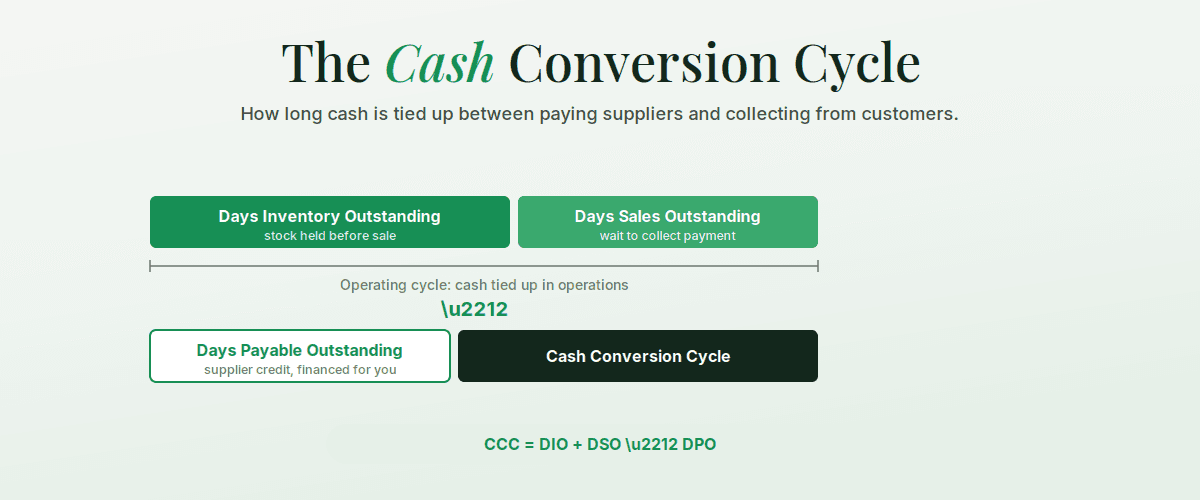
The cash conversion cycle combines the three into a single number: DIO plus DSO minus DPO (Investopedia). For this company, 61 plus 41 minus 41 gives about 61 days. That is how long the company’s cash is locked up in each cycle of operations: it pays for stock, waits for it to sell, waits again to collect, and only the credit it takes from its own suppliers offsets part of the wait. Shortening any of the three, selling stock faster, collecting sooner, or paying suppliers later, shortens the cycle and frees cash.
The Operating Cycle and the Cash Conversion Cycle
The two terms are close but not identical. The operating cycle is DIO plus DSO, the full length of time cash is tied up in operations from buying stock to collecting payment, 102 days for the company above. The cash conversion cycle subtracts DPO from that, because the credit the business takes from its suppliers finances part of the period at no cost, leaving 61 days that the business must fund itself.
The gap between the two is the value of supplier credit. A business that can stretch its payables without penalty shrinks the self-funded portion of its cycle. Some businesses push this far enough that the cash conversion cycle turns negative: they collect from customers before they have to pay suppliers, so growth actually generates cash rather than consuming it. This is normal for a cash-sales retailer with long supplier terms, and impossible for a manufacturer that pays for materials months before it gets paid, which is why the cycle is only ever judged against the nature of the business.
Why It Matters: The Trade-Off Between Liquidity and Profitability
Underneath every working capital decision sits a single tension. Holding more current assets, more cash, more stock, more generous credit to customers, makes the business safer, because it can always pay its bills and never runs short. But those assets earn little or nothing while they sit there, so more safety means lower returns. Holding less lifts returns, since the freed cash can be invested in the business, but it raises the risk of running out at the wrong moment. Working capital management is the continuous act of choosing a point on that line.
Businesses take one of three broad approaches to the choice.
Approach | Working capital held | Return | Main risk |
|---|---|---|---|
Aggressive | Low | Higher | Running short of cash, stockouts |
Conservative | High | Lower | Idle cash dragging on returns |
Matching (hedging) | Moderate | Balanced | Depends on accurate forecasting |
The aggressive approach funds as much as possible from short-term sources and keeps buffers thin, maximizing return but leaving little margin for error. The conservative approach keeps large buffers and funds current assets from long-term sources, which is safe but expensive in forgone returns. The matching approach funds permanent working capital with long-term finance and temporary needs with short-term finance, aiming to hold just enough, which balances the two but relies on forecasting the peaks correctly.
Common Working Capital Mistakes
Three failures account for most working capital trouble, and the first is the reason a profitable business can still collapse.
Overtrading. Growing sales faster than the cash to support them. Each new order ties up more cash in stock and receivables before the previous one has been collected, and a business can run out of cash while its order book and profits are both rising. Growth consumes working capital, and outrunning it is a common cause of a healthy-looking company failing suddenly.
Mistaking profit for cash. Reported profit is recorded when a sale is made, not when it is paid for. A business can show strong profit on paper while its cash is locked in unpaid invoices, and profit on an income statement is no guarantee of money in the bank.
Over-stretching payables. Delaying supplier payments frees cash, but pushed too far it damages the relationship, forfeits early-payment terms, and can lead suppliers to demand cash upfront or stop supplying, which is far more expensive than the cash it saved.
How Indian Banks Assess Working Capital Finance
Because most businesses fund part of their working capital with borrowing, how banks assess the requirement is a practical part of the subject. In India the framework is shaped by the Reserve Bank of India, and the most common instrument is cash credit, a facility that lets a business draw up to a sanctioned limit against its current assets and repay as cash comes in, alongside overdrafts and short-term working capital loans.
Two assessment methods are widely used. For smaller businesses, banks commonly use the turnover method, based on the Nayak Committee recommendation, which sets the working capital requirement at 25 percent of projected annual turnover; the bank finances up to 20 percent of turnover and the borrower contributes the remaining 5 percent as margin. For larger limits, banks assess the maximum permissible bank finance, a framework from the Tandon Committee that funds a portion of the working capital gap after the borrower’s own contribution. The Reserve Bank withdrew mandatory use of that formula in 1997, so banks now apply their own judgment, but its logic still underpins how limits are set (Reserve Bank of India).
Both methods come back to the operating cycle. A business with a longer cycle has cash tied up for longer and needs more financing to bridge the gap, which is why the ratios earlier in this entry are exactly what a lender examines before deciding how much to lend.
Terms People Often Mix Up
Working capital and cash flow
Working capital is a position at a point in time, the balance of current assets against current liabilities on a given date. Cash flow is a movement over a period, the cash coming in and going out across a month or a year. A business can have healthy working capital on paper and still have poor cash flow if its assets are tied up in stock and unpaid invoices.
Gross and net working capital
Gross working capital is the total of current assets. Net working capital subtracts current liabilities from it. Net is the more meaningful figure, because it shows what is left once short-term obligations are accounted for.
Working capital management and cash management
Cash management is one part of working capital management, concerned specifically with the cash balance. Working capital management is broader, covering receivables, inventory and payables as well, since all of them affect how much cash the business has free.
Liquidity and solvency
Liquidity is the ability to meet short-term obligations, which is what working capital measures. Solvency is the ability to meet all obligations over the long term, including long-term debt. A business can be solvent overall yet illiquid in the short term, which is the exact situation working capital management exists to prevent.
Where the Numbers Become a Constraint
Working capital management is learned mostly through models and ratios, and the calculations above can be done on paper by anyone. What is harder to teach is the pressure of it: the difference between computing a cash conversion cycle and watching cash sit in unsold stock while a supplier payment falls due and a customer has not yet paid.
Scaler School of Business runs an 18-month, full-time PGP in Management and Technology in Bengaluru, admitted on the strength of your profile with no CAT or GMAT. Because student teams run real ventures on real capital, they manage an actual working capital position rather than a hypothetical one, which turns the ratios in this entry from an exercise into a live constraint. The credential at the end is a PGP certificate, not a UGC degree - a full-time, on-campus program built for people who can commit to it fully.

Frequently Asked Questions
Q1. What is a good working capital ratio?
A: It depends on the industry. A current ratio of roughly 1.5 to 2.0 is a common reference, but a cash-based retailer runs safely below 1.0 while a manufacturer needs more. The ratio is judged against the sector norm, not a fixed target.
Q2. Can working capital be negative, and is that bad?
A: Not always. A negative cash conversion cycle, where a business collects from customers before paying suppliers, is a strength and generates cash as it grows. Negative net working capital can be a warning sign in a business that should be holding stock and receivables, so context decides.
Q3. What is the difference between working capital and cash flow?
A: Working capital is a balance at a moment in time; cash flow is the movement of cash over a period. A business can look healthy on working capital and still struggle for cash if its assets are tied up in stock and unpaid invoices.
Q4. Which industries need the most working capital?
A: Those with long operating cycles and slow-moving stock, such as manufacturing and construction. Businesses that sell for cash and hold little inventory, such as many retailers and software firms, need much less.
Q5. How does working capital management affect profitability?
A: Directly. Cash tied up in excess stock or slow collections earns nothing, so freeing it and putting it to work raises returns. Holding too little raises returns further but risks running short, which is the trade-off at the center of the subject.
Q6. What is the cash conversion cycle in simple terms?
A: The number of days between paying for stock and collecting the cash from selling it, less the time the business takes to pay its own suppliers. The shorter it is, the less cash the business has to fund itself.
Q7. How can a business improve its working capital?
A: By collecting from customers faster, holding less idle stock, and negotiating longer supplier terms without straining relationships. Each shortens the cash conversion cycle and frees cash.
Q8. Why can a profitable business run out of cash?
A: Because profit is recorded when a sale is made, not when it is paid for. If cash is locked in receivables and stock while bills fall due, a profitable business can still be unable to pay them, which is the danger of overtrading.

Non-IIM MBA
Top Non-IIM MBA Colleges in Bangalore (2026): Fees, Placements & How to Choose
5 min. read

MBA for Professionals
Is an MBA Worth It for Working Professionals? An Honest 2026 Guide
5 min. read

MBA for Engineers
MBA After B.Tech (2026): Eligibility, Specializations, Salary & Is It Worth It?
5 min. read

MBA for Engineers
MBA After Engineering (2026): Eligibility, Specializations, Salary & Is It Worth It?
5 min. read